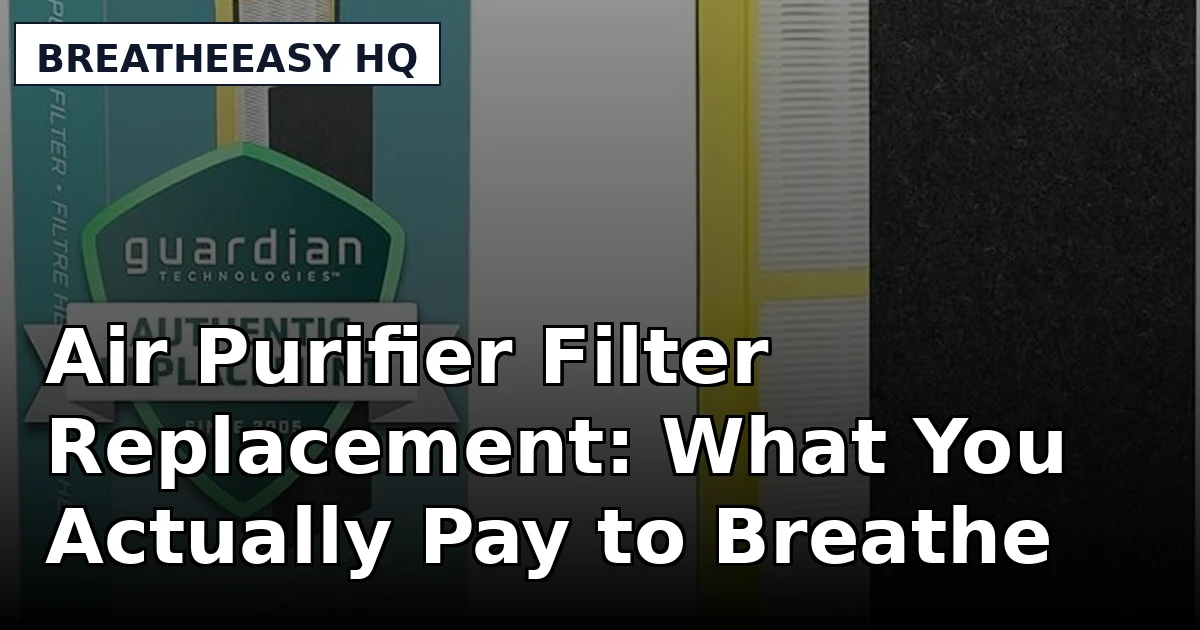
Buying the machine is the cheap part. Air purifier filter replacement is the number that decides whether the unit stays in your living room or ends up in the garage next to the treadmill. The box contains a fan, a housing, and a filter slot. The filter is the part that actually removes particles, and it is the part you will buy again and again for as long as you own the thing. That is why this guide covers four products together: three purifiers sized for different rooms, plus one genuine replacement HEPA filter, with room math and filter cost treated as part of the same purchase decision rather than an afterthought.
Related: How Often to Replace a HEPA Filter (and Why the Prefilter Decides) →
Quick answer
Match the purifier to the room you actually have, confirm it uses a true HEPA stage that sits in a sealed housing, and look up the replacement filter before you buy the machine. An undersized purifier will run at maximum speed forever and never catch up, and a purifier whose filters cost more than the unit after a year of ownership is a subscription you never agreed to. If you want the short version: pick the unit whose clean air delivery rate fits your square footage, then pick the unit whose filter you are willing to keep buying.
Four useful options
| Model | Best fit | What stands out |
|---|---|---|
| BLUEAIR Blue Pure 211i Max | Large open living spaces and open-plan homes | Manufacturer rating up to 3,235 sq ft, HEPASilent filtration, WiFi with Auto Mode |
| Winix 5300-2 | Bedrooms and mid-size rooms where odors matter | True HEPA plus PlasmaWave and an odor reducing carbon filter |
| Air Purifiers for Home Large Room, HAP603 | Budget-minded coverage of a big room | True HEPA, smart mode with PM2.5 display, sleep mode listed at 22 dB |
| GermGuardian Filter B HEPA Pure Genuine Filter | Refreshing an existing Guardian Technologies unit | Genuine HEPA replacement listed for wildfire smoke and odors |
The large-room anchor: BLUEAIR Blue Pure 211i Max
That square footage figure deserves a caveat. Manufacturer ratings assume an open space with good air circulation, and most homes are not one open space. A room with a closed door, a low ceiling, or a couch parked in front of the intake will behave like a smaller room than the label suggests. Treat the headline number as the ceiling of what the unit can do, not a promise for every floor plan.
Auto Mode is genuinely useful and also genuinely limited. The sensor reads particulate matter, which is the same thing a purifier is built to remove, so it responds well to smoke and dust. It does not read odors the way your nose does. If cooking smells are the problem, the carbon stage is doing that work, and no sensor setting will tell you when the carbon is spent.
The mid-size workhorse: Winix 5300-2
Three stages in one housing is the layout most people should be shopping for. The prefilter catches hair and lint, the carbon layer handles gases and odors, and the HEPA stage handles particles. Each stage wears out at a different rate, which is the whole point: you should not be replacing a HEPA filter because the carbon stopped absorbing kitchen smells.
On PlasmaWave, do your own reading before you decide. It is a manufacturer feature, opinions about it vary, and it is not the part of this machine doing the particle removal. The HEPA and carbon stages are the workhorses here.
The budget large-room option: HAP603
The PM2.5 display is a sensor readout, not a measurement instrument, and the difference matters. It tells you whether particles are trending up or down in the spot where the sensor sits. It will not tell you the concentration across the room, and it will not detect odors at all. Used as a trend indicator, it is genuinely handy. Used as proof that your air is clean, it is a number on a screen.
The 22 dB figure is a sleep-mode claim, which means one fan speed, not all of them. That is normal and not a knock on this unit, but it is worth being clear about what a single decibel number represents. A purifier that is quiet at low speed still has to move air at high speed when the room needs it, and moving air makes noise.
The consumable: GermGuardian Filter B HEPA Pure Genuine Filter
This is the product that makes the whole point of the article. It is a filter, not a purifier, and it is what you will buy every time the old one loads up. Buying a genuine replacement matters less because of the brand name on the media and more because of the fit: a filter that sits loosely in the housing lets air slip around the edges instead of through the media, and that bypass is the single most common way a working purifier quietly stops working.
Prices and availability may change. Product images, names, and retailer links must be matched by verified ASIN. Do not state a current price, rating, stock status, or measured result without current evidence.
What CADR actually tells you
Clean Air Delivery Rate is the only number that predicts whether a purifier will do anything in your room. It is expressed in cubic feet per minute of clean air delivered, and it is measured separately for dust, pollen, and smoke. A high CADR means the unit moves a lot of air through a real filter, quickly. A low CADR means it does not, no matter how large the housing looks or how many stages the marketing copy lists.
The practical rule of thumb is that CADR should be at least two thirds of your room's square footage, assuming a standard eight-foot ceiling. A 300 square foot bedroom wants roughly 200 CADR. A 600 square foot open living area wants roughly 400. If a listing gives you a room size but no CADR, you are being handed a coverage claim with nothing behind it.
This is also why the 99.97% figure, on its own, tells you almost nothing. It describes what fraction of particles a filter captures from the air that passes through it. It says nothing about how much air passes through per minute. A tiny filter in a big room still captures 99.97% of what it sees, and it sees very little.
Filter cost and the prefilter rule
Filter replacement is where the money actually goes. HEPA media typically needs replacing somewhere between six and twelve months of normal use, and it can be sooner if you run the unit at high speed around pets, smoke, or construction dust. Carbon layers exhaust faster than HEPA in odor situations because carbon adsorbs gases until it is saturated, and saturation happens on its own schedule.
A washable prefilter is the cheapest upgrade in this entire category. It catches hair, lint, and coarse dust before they reach the HEPA media, which stretches the interval between replacements. If your unit has one, clean it. If you are choosing between two units, this is a legitimate tiebreaker.
- Measure the room, including ceiling height, and write down the square footage you are actually trying to clean.
- Find the CADR figure for the unit and compare it against two thirds of that square footage.
- Look up the replacement filter part number and note what it costs before you buy the machine.
- Check how the filter seats in the housing and whether the manufacturer designed a gasket or seal around it.
- Decide where the unit will live, because placement changes performance more than most people expect.
Practical guidance
- Run the purifier at medium speed for everyday use and reserve the top speed for smoke events and cooking. Constant maximum speed burns through filters faster and rarely changes the outcome in a well-sized room.
- Keep at least six inches of clearance on every side, especially at the intake and outlet. A purifier pushed against a wall is a purifier working against itself.
- Clean the prefilter every two to four weeks with a vacuum or a rinse, depending on what the manufacturer allows. This is the single highest-return maintenance task on the machine.
- Budget the filter as a yearly expense from day one. If the annual filter cost bothers you at the time of purchase, it will bother you more in month ten.
- Watch the trend on any PM2.5 display rather than the absolute number. Rising readings during cooking or a smoke event tell you the unit is doing its job. A number that never moves at all is a sensor problem, not clean air.
- If you live in a wildfire smoke region, keep one spare filter on the shelf before smoke season. Replacement filters are the first thing to sell out when the sky turns orange.
Which option should you choose?
Choose the BLUEAIR Blue Pure 211i Max when you have a genuinely large or open-plan space and you want app control with Auto Mode handling the fan speed. Choose the Winix 5300-2 when you need a true HEPA unit with a carbon stage for a bedroom or mid-size room and want the odor layer built in. Choose the Air Purifiers for Home Large Room, HAP603 when the room is big but the budget is not, and an on-board PM2.5 readout is something you will actually use. Choose the GermGuardian Filter B HEPA Pure Genuine Filter when you already own a compatible Guardian Technologies purifier and the current filter is past due.
One caveat that applies to all four: none of these listings will tell you how the unit performs in your specific room. Coverage ratings are manufacturer figures, CADR is measured under test conditions, and neither accounts for your floor plan, your ceiling height, or where you put the machine. Buy based on the numbers you can verify, then judge based on what the filter looks like when you pull it out.
The bottom line
The purifier is a one-time purchase and the filter is a habit. Get the room size right, confirm there is a true HEPA stage with a proper seal, and price the replacement filter before you commit. A well-sized unit with a filter you can afford to keep buying will outperform a bigger, fancier machine that sits idle because the replacements cost too much. That math does not change with the brand name on the housing.