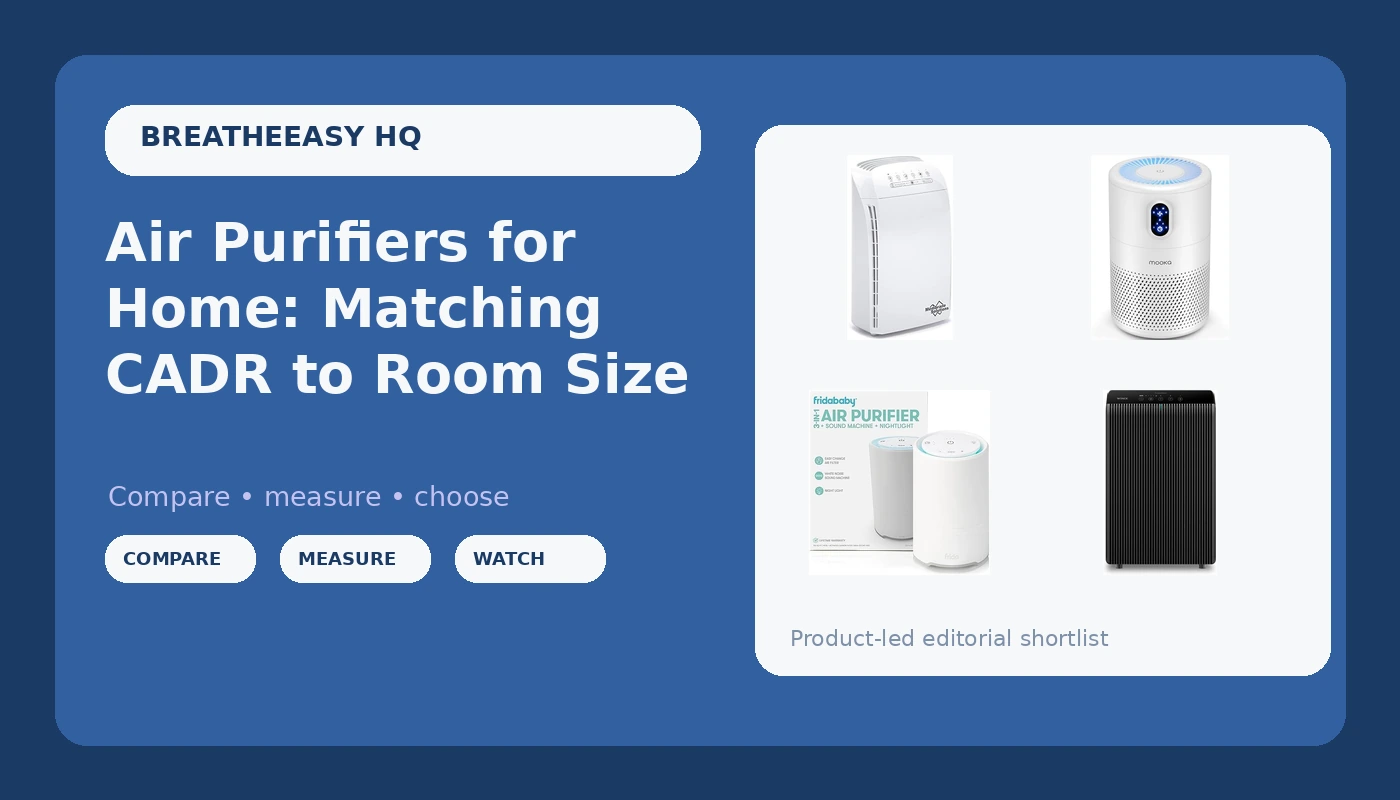
A room full of air purifiers for home use can look nearly identical on a spec sheet and behave nothing alike in a bedroom. I am Dana, an HVAC technician in Portland, Oregon, with fourteen years in the trade and eight of those spent doing indoor air quality work in houses with asthmatic kids, wildfire smoke pushing through window seals, and mold hiding behind drywall. The mistake I see most often is not a bad purchase. It is a mismatched one: a small unit doing duty in a living room, a large unit idling in a closet-sized office, a filter that quietly costs more per year than the machine did. This explainer covers four units worth putting on a shortlist, what each one is actually built for, and the numbers that decide whether it will work in your house.
Related: How to Read a CADR Number Before You Buy →
Quick answer
Match the unit's stated room size and its CADR to the room you will actually run it in, then check filter replacement cost before you buy. For a large open living area, the WINIX 5510 is the option here with the largest stated coverage and a carbon stage aimed at smoke and pet odors. For a mid-size room, the MOOKA B-D02L states coverage up to 1076 ft² with a True HEPA filter. For a nursery or small bedroom, the Frida Baby 3-in-1 pairs HEPA filtration with a sound machine, nightlight, and auto-off timer. The Membrane Solutions MSA3 is the plainest of the four, a straightforward home purifier without extra features to pay for.
Four useful options
| Model | Best fit | What stands out |
|---|---|---|
| WINIX 5510 Air Purifier | Large rooms and open floor plans | App support, True HEPA, high deodorization carbon filter, auto mode, stated coverage up to 1881 ft² in one hour |
| MOOKA Air Purifiers for Home B-D02L | Mid-size bedrooms and living rooms | True HEPA filter with stated coverage up to 1076 ft² |
| Frida Baby 3-in-1 Baby Air Purifier | Nurseries and small bedrooms | HEPA filtration plus sound machine, nightlight, three fan speeds, easy-change filter, auto-off timer |
| Membrane Solutions MSA3 Air Purifier | Simple whole-home use | Straightforward home purifier design with no added smart features |
The large-room option: WINIX 5510 Air Purifier
This is the unit in the group that is explicitly positioned for large spaces, and the stated coverage figure is the reason it leads here. When a manufacturer claims a room size, read it as a ceiling, not a target. The rating usually assumes a high fan speed, a closed room, and ideal mixing. In a real living room with a vaulted ceiling, a hallway opening, and a kitchen that vents into the same volume, you want headroom, and this is the option that has it. The carbon stage matters more than people expect. HEPA captures particles, not gases, so smoke odor and cooking smells need carbon to go anywhere. If you have cats or a smoker in the house, that second stage is doing real work, and it is also the stage that depletes fastest, so plan on replacing both filters on schedule rather than waiting for a smell to tell you.
The mid-size room option: MOOKA Air Purifiers for Home B-D02L
A 1076 ft² rating lands this one in the middle of the group, and mid-size is where most households should be shopping. A typical primary bedroom is 150 to 250 square feet. A living room might be 300 to 400. If the stated coverage is several times the room you are putting it in, you are paying for air you will never move, and if it is smaller than the room, you will run it on maximum forever and wonder why the dust settles anyway. The practical move with a unit like this is to run it on a medium setting where you can tolerate the noise, because that is the speed you will actually live with. One thing to confirm before buying: whether the replacement filter is sold as a single part number or a multi-pack, and how often the manufacturer says to change it. That interval is your real annual cost.
The nursery option: Frida Baby 3-in-1 Baby Air Purifier
Nurseries are where air quality advice gets emotional, and I understand why. This is a small-room product by design, and that is fine, because a nursery is a small room. What makes it interesting is the consolidation: a sound machine and a nightlight are things parents buy anyway, so a purifier that includes both removes clutter and outlets from a room that never has enough of either. Three fan speeds give you a low setting for sleep and a high setting for the twenty minutes before bed. The auto-off timer is a small feature that matters if you want the sound to fade after your kid is out. Treat the HEPA stage as the main event and the other two as conveniences, and check the filter part number before you commit, since easy-change designs vary in how easy and how expensive they are.
The simple home option: Membrane Solutions MSA3 Air Purifier
There is a real argument for the least complicated machine in the room. Every connected feature is another thing that can fail, another firmware update, another account, and one more reason the purifier does not turn on when the wifi drops. A purifier that runs on a physical button is a purifier that runs during a power flicker, a router outage, or a wildfire evacuation week when everything else is chaos. The trade-off is that you give up automatic speed adjustment and any remote control. If you are the kind of person who will actually walk over and turn the dial, that is not a loss. If you know you will not, auto mode is worth paying for, and you should look at the large-room option above instead.
Prices and availability may change. Product images, names, and retailer links must be matched by verified ASIN. Do not state a current price, rating, stock status, or measured result without current evidence.
What CADR actually tells you
CADR stands for Clean Air Delivery Rate, measured in cubic feet per minute of clean air delivered. It is the one number that predicts whether a purifier will change the particle count in your room, and it is the number that marketing percentages are designed to make you forget. A claim of 99.97 percent removal tells you what the filter media can capture in a lab, not how much air the machine pushes through it, not whether the air goes around the filter instead of through it, and not how the unit performs in a room with furniture and a closed door.
The rule of thumb that survives real-world use is two-thirds: look for a CADR that is at least two-thirds of your room's square footage, assuming an eight-foot ceiling. A 300 square foot living room wants a CADR around 200. That is not a marketing threshold, it is arithmetic about how many times per hour the machine can turn the room over. Two related notes. First, a purifier's CADR is measured at its highest speed, which is usually the loudest speed, so the number you care about is the one at the setting you will actually run overnight. Second, CADR is reported separately for smoke, dust, and pollen. If you are buying for allergies, the pollen and dust numbers matter more than smoke. If you are buying for wildfire season, look at the smoke number and the carbon stage behind it.
Filter cost and seal quality are the hidden numbers
The purchase price is the smallest number in the total cost of owning a purifier. HEPA filters load up and have to be replaced, and carbon stages deplete faster than HEPA because they are absorbing gases rather than trapping particles. Before you buy any unit, find the replacement filter part number and how often the manufacturer says to change it. Then multiply. A cheap machine with a filter that costs half the purchase price every six months is not a cheap machine. This is why a washable prefilter is worth looking for: it catches pet hair and coarse dust before they reach the HEPA, which stretches the expensive stage further. If a unit has no prefilter, you are replacing the main filter sooner, every time.
Seal quality is the other hidden number, and it is the one that separates a purifier from a fan with a filter in front of it. If air can bypass the filter media around the edges of the housing, the particle count in the room barely moves no matter what the filter is rated for. You cannot see bypass by looking at a product photo. You can look for a filter that seats with a firm gasket and a housing that clamps down on it, and you can check user reports about whether the replacement filter fits as snugly as the original. In my experience, a poorly sealed HEPA underperforms a well-sealed one with a lower grade of media, every single time.
- Measure the actual room, including any open doorway into a hallway or stairwell that shares the air.
- Find the CADR for smoke, dust, and pollen, and compare it to two-thirds of that square footage.
- Identify the replacement filter part number and the manufacturer's recommended change interval.
- Estimate annual filter cost, then compare it to the purchase price over three years.
- Decide whether you want auto mode and app control, or whether a manual dial is enough.
Practical guidance for real rooms
- Place the unit where air can actually circulate. Two to three feet of clearance on the intake side, and not tucked behind a sofa or curtain.
- Run it on the highest speed you can tolerate while you are awake, and drop to a lower speed for sleep. Medium is where most people live.
- Close the door. A purifier working in an open-plan space is fighting the whole house, and the room you care about will not clear as fast.
- Change the prefilter or vacuum it on schedule. A clogged prefilter starves the HEPA and makes the whole machine look weak.
- Budget the filter cost as a subscription, not a surprise. Put the part number in your phone with a reminder at the recommended interval.
- During wildfire smoke events, keep windows closed and run the unit continuously rather than cycling it on and off.
Which option should you choose?
Choose the WINIX 5510 Air Purifier when you have a large room or an open floor plan, want app control and auto mode, and need a carbon stage for smoke or pet odor. Choose the MOOKA Air Purifiers for Home B-D02L when you are filtering a primary bedroom, home office, or mid-size living room and want True HEPA coverage in that range. Choose the Frida Baby 3-in-1 Baby Air Purifier when the room is a nursery or small bedroom and you would rather have the sound machine and nightlight built in than sitting on the dresser. Choose the Membrane Solutions MSA3 Air Purifier when you want a straightforward home purifier with no connected features and no app to manage.
One caveat worth repeating: the room-size figures in these product names are manufacturer-stated coverage, not measured CADR at the speed you will run overnight. They are a starting point for comparison, not a promise about your specific room. The only way to know a unit is working in your house is to watch whether dust settles less, odors fade faster, and symptoms change over a few weeks.
The bottom line
Buy for the room, not for the feature list. Match stated coverage and CADR to the square footage you are actually filtering, confirm the replacement filter part number and interval before you check out, and pick the feature set you will genuinely use. The WINIX 5510 is the option here for large spaces and odor, the MOOKA B-D02L covers the mid-size rooms most households live in, the Frida Baby 3-in-1 is built around a nursery, and the Membrane Solutions MSA3 keeps things simple. Get the sizing and the filter math right, and any of these four will do more for your indoor air than a bigger machine in the wrong room.