Bedroom air purifiers are sold on square footage and sleep-mode decibels, and both numbers are easy to print on a box. The number that actually predicts whether your room gets cleaner is CADR, the clean air delivery rate, measured in cubic feet per minute. Everything else, including the coverage claim on the front of the carton, is context. If you are shopping for a bedroom unit to handle pet hair, pollen, dust, or wildfire smoke, four models cover the realistic range: a compact budget unit, a mid-size unit aimed at pet households, a large-room tower, and a premium quiet unit. What separates them is airflow at the speed you will actually run overnight, how well air is forced through the filter instead of around it, and what a year of replacement filters costs.
Related: HEPA Filter Replacement Costs: What a Year Really Adds Up To →
Quick answer
Match the purifier to the room volume first, then to your filter budget. A unit rated well above your bedroom's size will spend most of its life at low or medium speed, which is quieter and cheaper to run. A unit that is too small for the room never catches up to the particle load, no matter what the display says. For a typical bedroom, a compact filter-based unit is enough. For a large primary bedroom, an open-plan sleeping area, or a room shared with cats and dogs, size up and plan on higher filter costs. The four options here differ mainly in the coverage they claim, the filtration stage they use, and how much the replacement filters cost over a few years of nightly use.
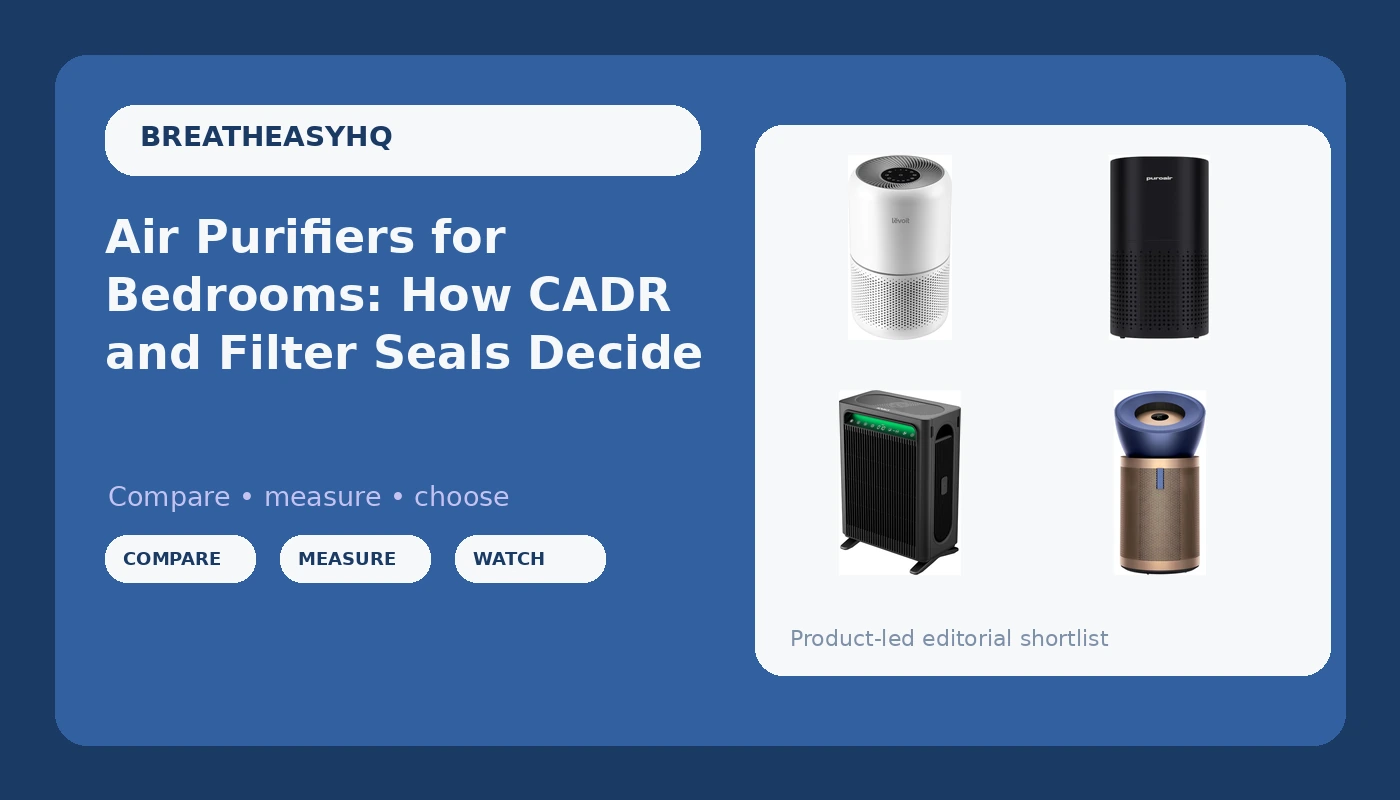
Four useful options
| Model | Best fit | What stands out |
|---|---|---|
| Levoit Air Purifier for Home Pets Hair Allergens in Bedroom Quiet Purifiers | Small single bedrooms | Compact format listed for pet hair, allergens, and quiet bedroom operation |
| PuroAir 240 HEPA Air Purifiers for Home Pets Bedroom - Filter 1,000 Ft² | Mid-size bedrooms with pets | HEPA filtration named in the listing plus a 1,000 square foot coverage claim |
| KNKA Air Purifiers for Home Bedroom Up to 1,695 Ft² in 1 Hr, APH4000, Black | Large rooms and open sleeping areas | Manufacturer claim of up to 1,695 square feet in one hour |
| Dyson Big+Quiet Formaldehyde Air Purifier, Blue/Gold (Renewed) | Premium setups and formaldehyde concerns | Renewed unit with formaldehyde filtration and a quiet-focused design |
Small-room pick: Levoit Air Purifier for Home Pets Hair Allergens in Bedroom Quiet Purifiers
The trade-off here is coverage, not complexity. A compact unit like this works when the room is genuinely small and the door stays closed. People buy it for a living room or an open-plan space and then wonder why the air still smells like the dog, because the machine is moving maybe a fraction of the air that room needs. Check two things before committing: the filter specification and price printed on the listing, and how the filter seats in the housing. If you can see a visible gap around the filter media, air is bypassing it, and you are paying for noise rather than clean air.
Mid-size option: PuroAir 240 HEPA Air Purifiers for Home Pets Bedroom - Filter 1,000 Ft²
Read coverage claims carefully, because they are usually written against one air change per hour. One air change per hour is barely maintenance level. For a bedroom where allergies or smoke matter, you want the air turned over several times per hour while you sleep. A 1,000 square foot claim therefore does not mean the unit will scrub a 1,000 square foot room the way a bedroom needs to be scrubbed, and it definitely does not mean that on low speed. What the larger claim does tell you is that the fan and filter are sized above the smallest units, which gives you headroom to run at medium speed in a normal bedroom and still move meaningful air.
Large-room option: KNKA Air Purifiers for Home Bedroom Up to 1,695 Ft² in 1 Hr, APH4000, Black
That phrase "in 1 hr" is doing a lot of work, and it is worth understanding exactly what it commits the machine to. One air change in an hour across 1,695 square feet means the unit is moving a large volume of air once, not cleaning a bedroom five times over. Divide the claimed coverage by four or five to get the size of room it can genuinely keep up with overnight. Where a high-airflow tower earns its place is in a large primary bedroom, a loft, or a room with multiple pets, because you can run it below maximum and still get useful turnover. The cost of that headroom is noise at the top speeds and, usually, a larger and more expensive filter.
Premium quiet option: Dyson Big+Quiet Formaldehyde Air Purifier, Blue/Gold (Renewed)
Two things need to be kept separate here. The first is the renewed status: a renewed unit has been returned, inspected, and resold, and the condition can range from indistinguishable from new to cosmetically marked. Check the seller's return window and warranty terms before you commit, and confirm which filters ship with the unit. The second is what you are buying. Dyson purifiers are built around airflow and industrial design, and the formaldehyde handling is a real filtration stage rather than a scent feature. That combination suits a bedroom where noise matters and where new furniture, paint, or flooring is off-gassing. What it does not change is the arithmetic: premium hardware carries premium filter costs, and those recur.
Prices and availability may change. Product images, names, and retailer links must be matched by verified ASIN. Do not state a current price, rating, stock status, or measured result without current evidence.
What CADR actually tells you
CADR is expressed in cubic feet per minute of clean air delivered, usually broken out separately for smoke, dust, and pollen. It is measured with the unit on its highest setting in a controlled chamber, which is the first caveat: the number you get on low speed at 2 a.m. is lower, often substantially. To convert CADR into air changes per hour for your room, multiply the CADR by 60 and divide by the room's volume in cubic feet. A 10 by 12 foot bedroom with an 8 foot ceiling holds 960 cubic feet. A purifier delivering 120 CFM of clean air turns that room over about 7.5 times per hour at maximum. Drop to a third of that airflow on low, and you are near 2.5 air changes per hour, which is a maintenance level rather than a cleaning level.
The practical rule of thumb is to look for a CADR at least two thirds the size of the room's floor area, and higher if allergies, pets, or smoke are involved. A 150 square foot bedroom therefore wants a CADR around 100 or better, ideally closer to 150. That is why coverage claims and CADR are not interchangeable, and why a unit marketed for 1,000 square feet may sit comfortably in a bedroom while a compact unit marketed for the same bedroom may be working at its ceiling. If the listing does not state CADR, treat the coverage number as a marketing figure until you find it.
The cost nobody budgets for
The purchase price is the entry fee, not the total. Replacement filters are the real cost of ownership, and they vary enormously between brands and models. A rough way to plan is to find the replacement filter listing for whichever model you are considering and multiply its cost by the number of changes per year the manufacturer recommends, then add that to your mental budget for the machine. On units with a washable prefilter, the main filter tends to last longer because pet hair and coarse dust are captured before they reach the fine media. On units without one, the filter loads faster in a pet household and gets changed more often.
Two related details matter as much as the filter price. First, seal quality: a filter that does not seat tightly lets air bypass the media entirely, which quietly erases a chunk of the performance you paid for. Press the filter into its housing and look for gaps. Second, activated carbon: it handles odors and some volatile compounds, but it depletes faster than the particle filter and is often a thin layer. If odor control is the goal, look at how much carbon is in the filter rather than whether the word appears on the box.
- Measure the bedroom in feet and multiply length by width by ceiling height to get cubic feet.
- Find the CADR figure for the unit you are considering, at maximum speed, and confirm the room's air changes per hour using the conversion above.
- Estimate how often you will realistically run it at medium or low, since that is the speed you will live with overnight.
- Look up the replacement filter listing and price before you buy the machine, not after.
- Inspect the filter seating and the housing for gaps, because bypass is the most common failure on lower-cost units.
Getting the most out of a bedroom unit
- Keep the unit at least a foot off the wall and clear of curtains so the intake and exhaust are not blocked.
- Run it on medium or auto overnight rather than maximum, unless smoke or a flare-up justifies the noise.
- Close windows during wildfire smoke events and run the purifier continuously rather than in short bursts.
- Vacuum or rinse a washable prefilter every few weeks in a pet household to protect the main filter.
- Replace the main filter on schedule, and photograph the date you installed it so you can track the interval.
Which option should you choose?
Choose the Levoit Air Purifier for Home Pets Hair Allergens in Bedroom Quiet Purifiers when you are treating a single small bedroom and want a compact, simple machine. Choose the PuroAir 240 HEPA Air Purifiers for Home Pets Bedroom - Filter 1,000 Ft² when you want HEPA filtration with more coverage headroom for a mid-size bedroom and pets. Choose the KNKA Air Purifiers for Home Bedroom Up to 1,695 Ft² in 1 Hr, APH4000, Black when the room is large, open, or heavily occupied and a compact unit would be undersized. Choose the Dyson Big+Quiet Formaldehyde Air Purifier, Blue/Gold (Renewed) when quiet operation and formaldehyde filtration matter and you are comfortable buying renewed hardware with seller-specific warranty terms.
A caveat on all four: the coverage figures quoted above are manufacturer claims, not independently measured results, and CADR ratings are established at maximum fan speed in a test chamber. Your room, its furniture, its door position, and the speed you actually select will all change the real number. Verify the current CADR, filter specification, and replacement cost on the live listing before you buy, and check the terms carefully on any renewed unit.
The bottom line
Buy for the room you have, not the room on the box. Measure the volume, work out the air changes per hour you need, then pick the smallest unit that delivers that at the speed you can sleep through. The Levoit fits a single small bedroom. The PuroAir 240 steps up in coverage for a mid-size bedroom with pets. The KNKA tower is the one to consider when the space is large or open. The renewed Dyson is the premium path, with quiet design and formaldehyde filtration, provided the seller terms check out. Whichever you pick, budget for the filters from day one, because that recurring cost, not the sticker, is what you are really signing up for.