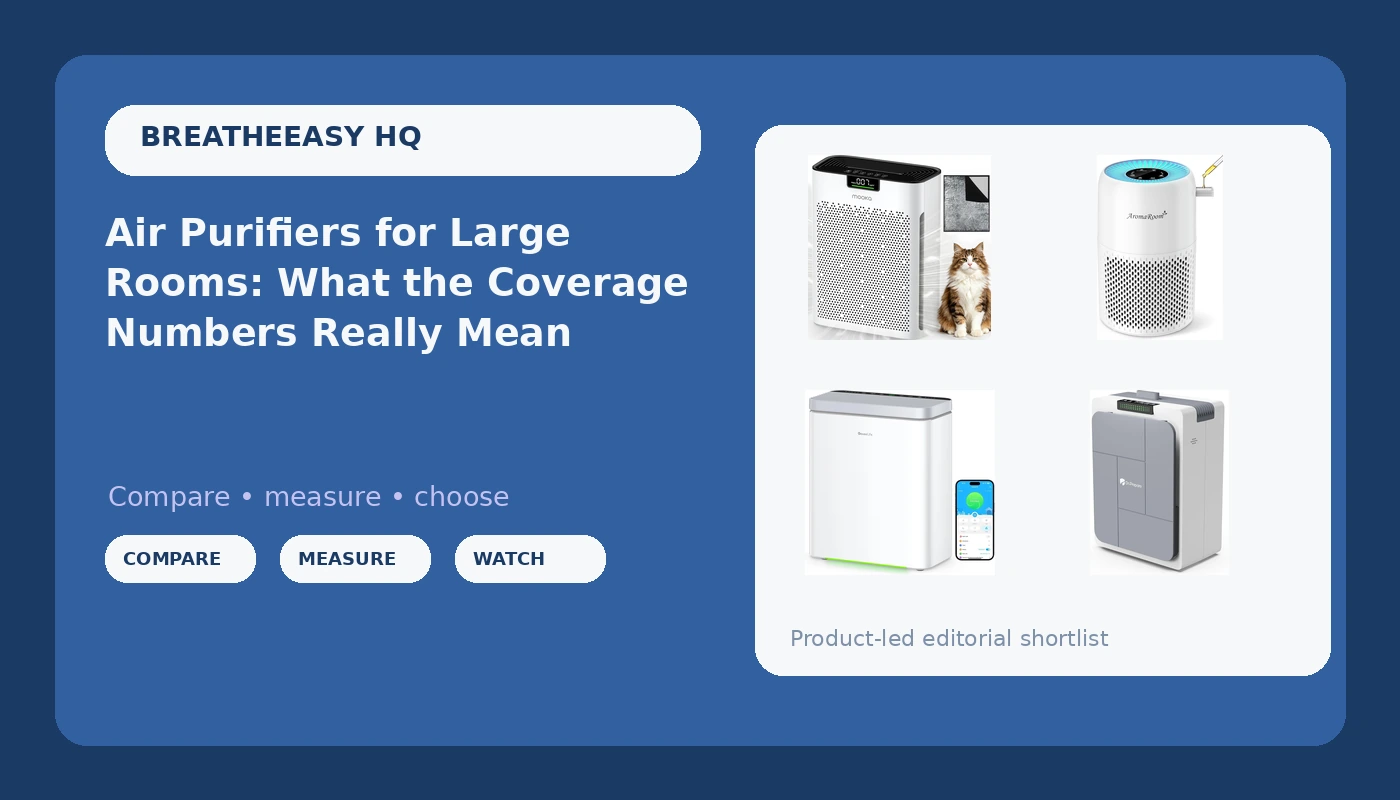
Walk through the purifier aisle, physical or digital, and every box says the same thing: cleaner air, better sleep, fewer allergens. None of that is a specification. What actually separates one machine from another is how much filtered air it moves, how well the filter is sealed into the housing, and what it costs you to keep the thing running past month three.
This is an explainer, not a ranking. Below are four air purifiers for large rooms and bedrooms that are currently sold, described using what each manufacturer's own listing states, followed by the numbers and habits that decide whether any of them will do what you want in your house. Coverage figures in this category are manufacturer-stated maximums, and they describe a best case. The useful work is figuring out which of those cases looks like your room.
Related: How to Size an Air Purifier for a Bedroom →
Quick answer
Match the machine to the room before you shop features. Manufacturer-stated coverage describes the largest space a unit is rated for, and the numbers that predict real performance are CADR (clean air delivery rate) and the annual cost of replacement filters. Among the four units here, the Dr.Prepare model pairs a double-sided intake with a built-in air quality sensor and a washable pre-filter, the MOOKA unit carries the largest stated coverage in the group, the AromaRoom unit uses a three-in-one filter stack aimed at bedrooms, and the GoveeLife model leans on smart controls for large rooms. None of that substitutes for checking CADR and filter cost against your specific space.
Four useful options
| Model | Best fit | What stands out |
|---|---|---|
| Dr.Prepare Air Purifier for Home Large Room up to 1130 ft² | Rooms near the 1,130 sq ft stated coverage where sensing and a dual intake matter | Double-sided HEPA air intake, smart air quality sensor, washable pre-filter, listed 22 dB sleep mode, aroma option |
| MOOKA Air Purifier for Home Bedroom Large Room 2200 Ft² | The largest open spaces in this group | Manufacturer-stated coverage up to 2,200 sq ft with HEPA filtration |
| AromaRoom Air Purifiers for Bedroom with 3-in-1 Filters | Bedrooms and secondary rooms | Three-in-one filter stack in a bedroom-focused design |
| GoveeLife Smart Air Purifier for Home Large Rooms | Large rooms where app control and scheduling matter | Manufacturer-stated coverage up to 1,046 sq ft with smart controls |
Sensor and dual-intake pick: Dr.Prepare Air Purifier for Home Large Room up to 1130 ft²
A double-sided intake is a real design choice, not a marketing word. Pulling air from two faces roughly doubles the filter surface area for a given airflow, which means the air moves through the media more slowly and the fan does not have to scream to hit a given CADR. The practical trade is that you are buying two filter panels instead of one when replacement time comes, so the annual cost math changes.
The washable pre-filter is the part I care about most on this machine, because it is the cheapest way to protect the expensive stage. Pet hair, dust bunnies, and lint get caught before they ever reach the HEPA media, and you rinse it instead of buying it. Skip that step and the HEPA loads up months early. The sensor is worth understanding for what it is: it reads particles, typically PM2.5, and displays a number. It does not read odors, so a kitchen smell or a candle will not necessarily move the reading even when the air in the room is genuinely worse than the display suggests.
Big-room coverage pick: MOOKA Air Purifier for Home Bedroom Large Room 2200 Ft²
A 2,200 sq ft coverage claim is the biggest number in this group, and it deserves the most skepticism, not the least. Coverage figures of that size generally assume open floor space, a high fan speed, and a ceiling height that matches the test conditions. Put the same unit in a 2,200 sq ft house with interior walls, closed doors, and furniture, and you are cleaning one room, not the floor plan.
The other thing a large coverage number usually implies is noise on the setting that achieves it. Physics does not negotiate here: moving more air takes more fan, and more fan makes more sound. If a unit is genuinely inaudible on its top speed, it is not moving the air its coverage number claims. The honest way to read this listing is as a machine with headroom for a big room at high speed, and a gentler setting for the hours when you are actually in the room.
Bedroom filter-stack pick: AromaRoom Air Purifiers for Bedroom with 3-in-1 Filters
A three-in-one filter is convenient and it comes with one catch worth knowing before you buy. When the pre-filter, the HEPA media, and the carbon layer are bonded into one cartridge, you replace all three at the same time whether or not each stage is spent. Carbon is usually the first to give out on odors, while the HEPA media still has life left in it, so you end up buying a new HEPA stage to get the carbon you actually needed.
That does not make the design bad. It makes the annual cost predictable and the replacement process simple, which matters if you know you will not fuss with three separate parts. What it does mean is that this is a bedroom machine in the literal sense: the room it is sized for is a bedroom, and buying it for a large open living space is a mismatch. Small room, small unit, done well, beats a large unit that never gets out of low speed.
Smart-control pick: GoveeLife Smart Air Purifier for Home Large Rooms
Smart features are genuinely useful in exactly one scenario: you want the purifier to react to the room when you are not standing in it. Schedules that run the unit harder before you get home, a notification when the filter is due, a reading you can check from the couch. That is a real convenience, and for a lot of households it is the difference between a purifier that runs daily and one that gets unplugged in February.
The caution is the same one that applies to every connected purifier. An app sensor reports particles, usually PM2.5, and it does not smell the air. It will not tell you the cat litter box needs changing or that something is offgassing from new furniture. It also should never be the only way to turn the machine on. If the Wi-Fi drops or the app breaks, a purifier that cannot be operated from its own panel becomes a very expensive box with a filter inside it.
Prices and availability may change. Product images, names, and retailer links must be matched by verified ASIN. Do not state a current price, rating, stock status, or measured result without current evidence.
What CADR actually measures
CADR stands for clean air delivery rate, and it is expressed in cubic feet per minute of clean air. It is measured separately for dust, pollen, and smoke, because a filter that catches pollen easily may struggle more with fine smoke particles. That distinction matters if you live somewhere with wildfire season, because the smoke number is the one that predicts how the unit behaves when the sky turns orange.
Here is the rule of thumb I use in the field. At a standard eight-foot ceiling, a CADR equal to roughly two thirds of a room's square footage gets you near five air changes per hour in that room. So a 300 sq ft bedroom wants a CADR in the neighborhood of 200, and a 600 sq ft living area wants something near 400. Anything less and you are buying a fan with a filter in it.
Two details get buried constantly. First, CADR is usually published at the highest fan speed, which is the setting nobody leaves on while sleeping. Second, a single CADR number does not tell you how the unit performs at medium, which is where most people actually run it. A machine with a strong high-speed number and a weak medium setting is a machine you will rarely use at the speed that earned it the rating.
What the spec sheet leaves out
Seal quality is the invisible variable. Air that slips around the filter instead of through it is unfiltered air, and it is the most common failure on inexpensive units. A perfectly good HEPA media with a loose gasket performs like an open window with a filter nearby. You cannot see this on a listing photo, but you can feel it: a well-sealed unit forces air out of the exhaust with authority, and the filter sits snug with no wobble.
Filter replacement cost is the other omission, and it is the real price of the machine. Nobody budgets for it, then the first cartridge arrives at the door and the math changes. Do that math before you buy, not after. Take the price of a replacement filter, multiply by how many you will go through in a year, and treat that as part of the purchase.
And then there is the marketing language itself. A "99.97 percent removal" claim with no CADR attached tells you almost nothing about performance in a room. HEPA is HEPA. The brand name printed on the filter housing matters far less than whether the media is sealed, the pre-filter is clean, and the machine is the right size for the space.
- Measure the actual room, length times width, and note the ceiling height. Include the closets and alcoves if the door stays open.
- Find the CADR figures, including the smoke number, and note which fan speed they were measured at.
- Price a replacement filter and estimate how many you will need in a year. That is the real cost of ownership.
- Check the seal by hand when the unit arrives. The filter should sit tight, with no visible gap around the edges.
- Decide which speed you will realistically run it at, then judge the noise at that speed rather than the marketing label on the box.
Setting one up so it actually works
- Give the intake at least a foot of clearance from the wall and furniture. A purifier pressed into a corner is a purifier working against itself.
- Close the door to the room you are cleaning. A purifier does not clean a whole house through open doorways, no matter what the coverage number says.
- Rinse or vacuum the pre-filter every two to four weeks if you have pets. This single habit extends HEPA life more than anything else you can do.
- Replace the HEPA stage on schedule, not when it looks dirty. Filters look gray long before they are spent, and they can look fine while airflow has already dropped.
- Fix the source before you buy the machine. A purifier manages airborne particles. It does not stop a leak, a mold problem, or a cat box, and no CADR number will change that.
Which option should you choose?
Choose the Dr.Prepare Air Purifier for Home Large Room up to 1130 ft² when you want a dual-sided intake, a built-in particle sensor, and a washable pre-filter in a unit rated for a large room. Choose the MOOKA Air Purifier for Home Bedroom Large Room 2200 Ft² when your priority is the largest stated coverage figure in this group and you understand that the number describes a best case. Choose the AromaRoom Air Purifiers for Bedroom with 3-in-1 Filters when the room is genuinely a bedroom and you want one cartridge to swap instead of three separate stages. Choose the GoveeLife Smart Air Purifier for Home Large Rooms when app control, scheduling, and remote readings are worth paying for, and the unit can still be operated from its own panel.
The caveat that applies to all four: coverage numbers are manufacturer-stated maximums, and no listing here substitutes for a CADR figure measured at the speed you will actually run. Verify the current specs, the filter price, and the seal on the specific unit you receive, because the same model can change between production runs.
The bottom line
Buy the room size first, the filter cost second, and the features third. A machine with a modest CADR that you run every night in a closed bedroom will beat a larger unit that sits on low speed in an open floor plan, and it will beat it by a wide margin. The four purifiers here cover the useful spread: a sensor-driven dual-intake unit, a large-coverage workhorse, a bedroom cartridge machine, and a smart-connected option for people who want the app.
If you cannot find a CADR number for a purifier you are considering, that is your answer. Move on. The number exists for every unit worth owning, and the absence of it tells you more about the product than any badge on the box.