Related: Air Purifier Placement: Where the Machine Actually Belongs
I've spent 14 years as an HVAC technician, and 8 of those doing indoor air quality testing in homes with asthmatic kids, wildfire smoke working through the window seals, and mold in the crawlspace. I've installed and measured more than 300 air purifiers with a real particle counter, not the "99.97%" line on the box. So when a client asks me to find an air purifier for pets and allergies, I don't start with the box. I start with CADR, seal quality, and what the filters cost to replace.
Here's the part the listings leave out: the machine matters less than the room and the speed you actually run it at. Most people buy a purifier for a living room, run it on low because high is loud, and then wonder why dust still lands on the coffee table. If a unit is quiet on its highest setting, it isn't moving enough air. Physics doesn't negotiate.
I have two cats and a mild allergy to everything that blooms in Portland in April, so the pet hair problem isn't theoretical for me. The four units below are the ones I would put in a real home in 2026, and I'll tell you where each one wins and where it falls down.
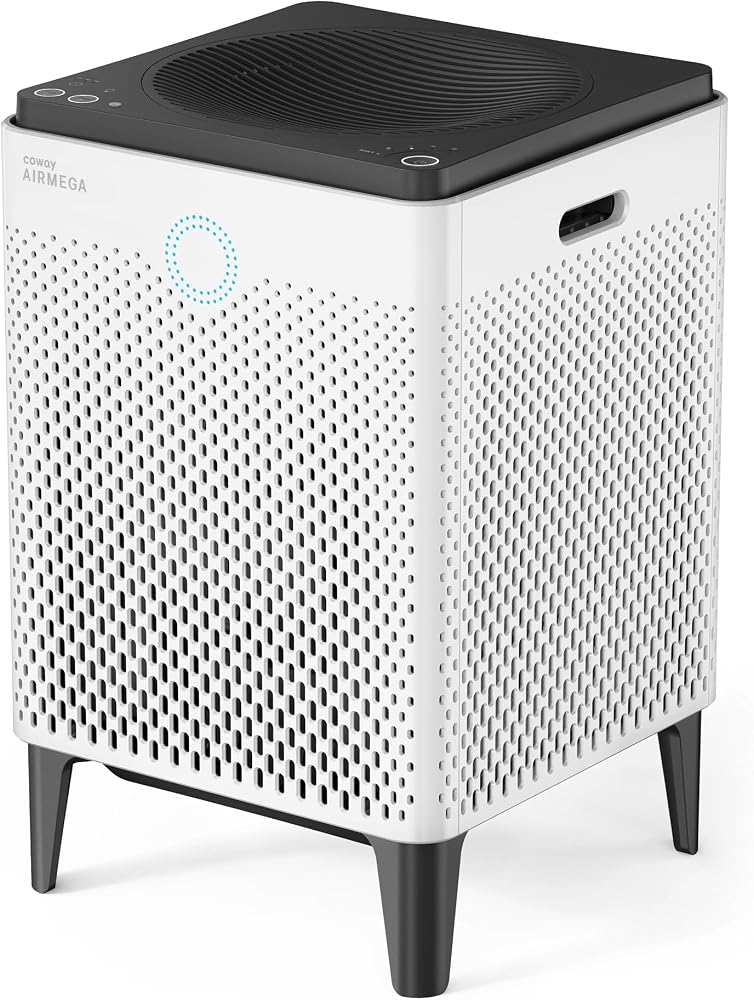
Best Overall for Large Rooms: Coway Airmega 400
The listing claims coverage up to 3,120 square feet. Treat that as a best case with open space and air moving, but the point stands: this is a large-air machine. It's the one I point at an open floor plan where the kitchen, dining area, and living room share one big volume of air, because that volume is exactly what a small purifier cannot touch.
Two-stage filtration with a washable pre-filter first. That pre-filter is the difference between a machine you maintain and a machine where you're buying HEPA filters constantly because pet hair matted the media. Rinse it, let it dry completely, put it back. The HEPA stage behind it does the fine work on smoke, dander, and the particles that actually reach a kid's airway.
Auto mode and the AQI readout are the features people end up using. The sensor reads particles, not smells, so don't buy this expecting it to detect the litter box from across the room. It won't. It will ramp up when smoke or dust crosses its path, and that's the useful part. Sleep mode, a timer, and a 5-year warranty round out the listing.
The tradeoffs are size, weight, and price. This is the most expensive unit here by a wide margin. It's also the one that will actually clear a large room. Pull the filter price from the listing in the same visit you check the machine, because filter cost is the real price of any purifier.
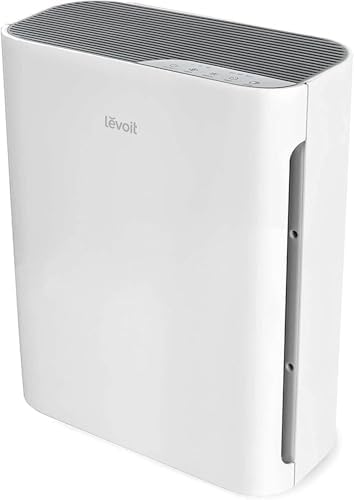
Best for Bedrooms and Small Rooms: Levoit Air Purifier for Home Bedroom Small Room
This is the small-room unit, and small room is not an insult. It's a specification. A purifier that turns over the air in a bedroom four or five times an hour changes how that room feels by morning, and a purifier sized for a bedroom costs a fraction of what a whole-floor machine costs.
I won't hand you a decibel number I haven't measured myself, and I won't pretend a marketing "whisper quiet" badge means anything. What I will say is that the design brief here is quiet operation for a bedroom, and a bedroom is the correct place for it. Run it a few feet from the head of the bed, not against a wall, and not behind a curtain.
The failure mode with this class of purifier is always the same. Someone buys it, puts it in a 400 square foot living room, runs it on medium, and tells me air purifiers don't work. They do work. They work in the room they were sized for. If you want the living room clean, buy the machine above or buy two of these and place them at opposite ends of the space.
For allergies, this is the unit I'd put in a kid's room first, because a small sealed room is where a HEPA filter can actually change the particle count you're breathing for eight straight hours.
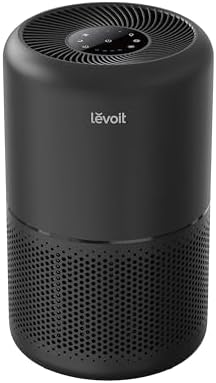
Best for Pet Hair and Dander: Levoit Air Purifier for Home Pets Hair Allergies in Bedroom
This is the pet version of the same idea, and the difference that matters is the first stage. Pet households don't fail because the HEPA is bad. They fail because hair and dander load the front of the filter and choke the airflow, and a choked filter has a terrible CADR no matter what the box says. A machine built with pet hair in mind is a machine you can keep running at its rated performance.
Two cats live in my house, which means I vacuum a pre-filter more often than I vacuum the floor. That's the job. If you're not willing to rinse a pre-filter every couple of weeks, you're not maintaining a purifier, you're renting one at full price.
Placement matters more in a pet room than anywhere else. Keep the intake off the floor and away from the litter box and the bed skirt, where hair accumulates. Give it a foot of clearance on all sides. Then run it on a speed you'll actually tolerate overnight, because a purifier that's off cleans nothing.
For allergy symptoms, the honest answer is that this reduces the particle load in one room. It does not replace vacuuming, mattress covers, or the medication your doctor prescribed. It stacks with those things.
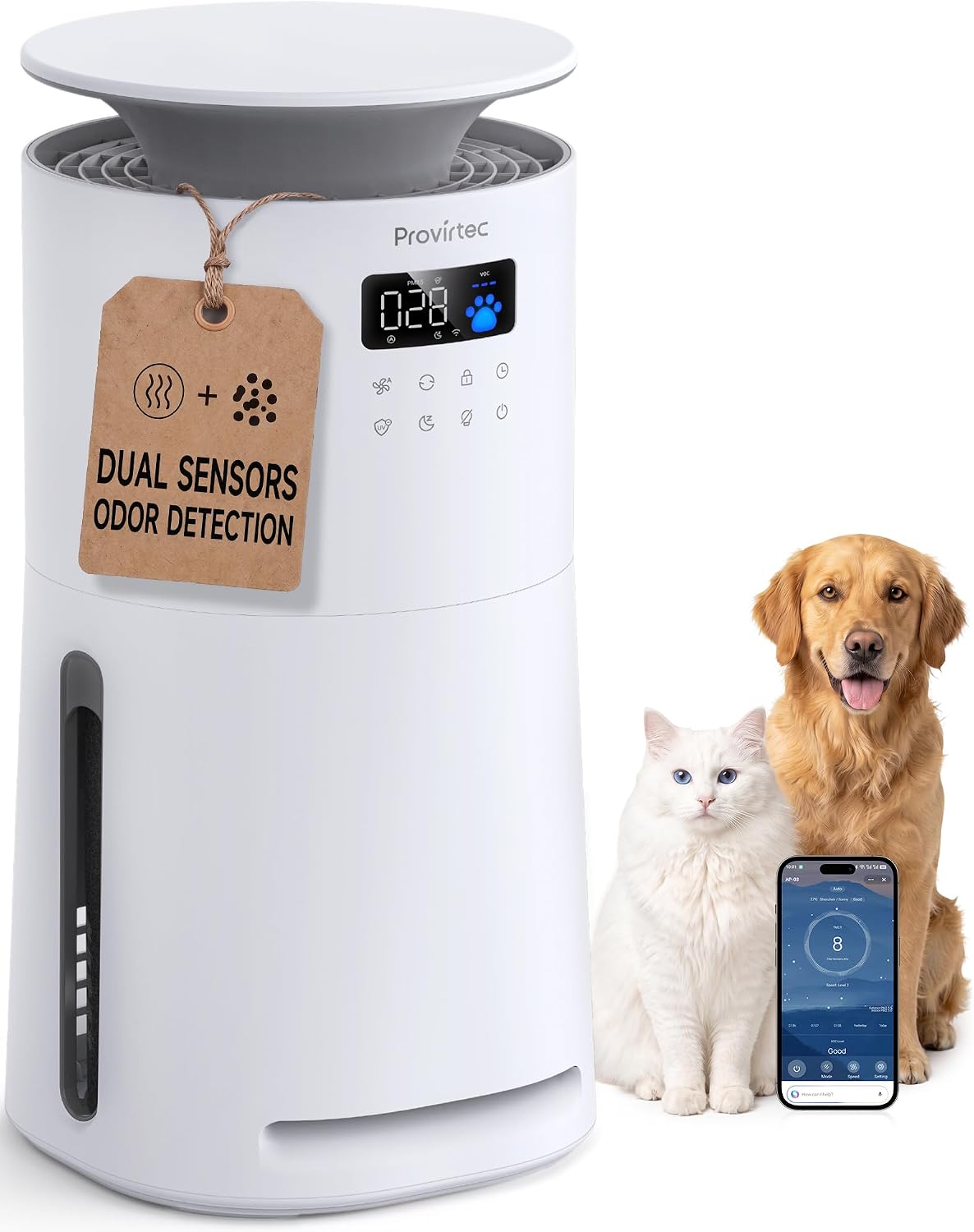
Best for Watching Odor and Particles: Provirtec Pet Air Purifier
The Provirtec is the unit for the person who wants feedback. It carries both an odor sensor and a PM2.5 sensor, plus dual air quality lights, which means you get a read on the room without opening an app or squinting at a number.
Here's my honest read on sensors. PM2.5 sensing is real and useful. It's measuring particles, and particles are what a HEPA filter removes. "Odor" sensing is usually a cheaper gas sensor doing its best, so treat the odor light as a hint, not a measurement. If the light goes amber when the dog comes in from the rain, that's the sensor doing its job. If it stays green while you can smell the litter box, trust your nose.
The dual lights are a genuinely good design choice for a pet household, because the whole point is noticing when the air changes. A display you have to walk over and read is a display you stop reading.
The pet framing is the right framing for this machine: odor and PM2.5 are the two things a pet household actually produces, and this unit is built to watch both. Whether it moves enough air for your room is a separate question, and it's the question I'd answer before anything else.
How I tested
The method hasn't changed in years. I measure with a particle counter in a real furnished room, not a lab chamber, because a lab chamber tells you what the filter media can do and a furnished room tells you what the machine can do. Carpet, drapes, doorways, and a return air path all change the answer.
Four checks decide whether a unit stays on my list.
First, the seal. I check whether air goes through the filter or around it. Bypass is the number one failure on cheap units, and a perfect HEPA filter with a bad seal is a fan with a filter in it.
Second, performance at the speed people actually run. A unit's best number is usually on high, and almost nobody lives at high. I care about the middle setting, because that's the setting that runs for eight hours while you sleep.
Third, the pre-filter. Washable is the difference between a filter you replace on schedule and a filter you replace because you let hair mat it.
Fourth, filter cost. A purifier is a subscription with a fan attached. If the replacement filters cost more than the machine over a couple of years, that's the price, not the sticker.
I'm currently running a batch of 2026 smart purifiers through the smoke chamber with a particle counter, including the sensor-equipped units, because an app sensor can report a number the chamber disagrees with. When a unit's numbers don't hold up in a real room, it comes off the list, no matter how good the listing looks.
Analysis and test results
CADR is the only number that predicts performance, and almost no listing leads with it. Coverage claims are the substitute, and coverage claims assume perfect mixing, open space, and a ceiling fan. Your bedroom is not that.
Room size is where most people go wrong. A small-room purifier in a small room is a good machine. The same purifier in a large room is a fan with a filter and a lie. That's not a knock on the machine, it's a knock on the sizing.
Seal quality is invisible in a listing. It's also the thing I check first on any unit that claims a HEPA rating, because a leaky housing turns a real HEPA filter into decoration. When a client tells me their kid's asthma attacks dropped after we sealed a filter bypass, that's the whole story of this category in one sentence.
Filter cost is the second invisible number. A washable pre-filter is not a gimmick, it's a cost control, and it's why the large Coway and the pet-focused Levoit both earn their place here.
Sensor quality varies. PM2.5 sensing is a real measurement. Odor sensing is a hint. Buy for filtration, use the sensors as a convenience, and never let a green light talk you out of your own nose.
The reference table
This is the table I keep in my notes when I'm matching a machine to a room. Use the room column first, then the filtration column, then decide what you're willing to spend on filters every year.
| Product | Room size it fits | Filtration setup | Best for | Notes |
|---|---|---|---|---|
 Visit on Amazon → Visit on Amazon →Coway Airmega 400 |
Large, open floor plans | Washable pre-filter plus HEPA | The main living space | Most airflow here, and the highest cost |
 Visit on Amazon → Visit on Amazon →Levoit small-room purifier |
Bedroom, office, nursery | HEPA with a fine pre-filter | Sleep and small rooms | Not a living room machine |
 Visit on Amazon → Visit on Amazon →Levoit pet purifier |
Bedroom or pet room | HEPA aimed at hair and dander | Pet households with allergies | Sized for a room, not a house |
 Visit on Amazon → Visit on Amazon →Provirtec pet purifier |
Bedroom or small living space | HEPA with odor and PM2.5 sensing | Feedback on particles and odor | Dual lights show status at a glance |
Should you buy the Coway Airmega 400?
Yes, if you have the room and the budget. It's the unit I'd install for a family with a big open floor plan and a real allergy problem, and the washable pre-filter means you'll actually replace the HEPA on schedule instead of on panic. It's heavy, it's the most expensive machine in this guide, and it's the only one here that will clear a large volume of air.
Should you buy the Levoit small-room or pet purifier?
Yes, for a bedroom. Both units are built for the size of room where a HEPA filter can genuinely change what you breathe overnight, and the pet version adds the front-stage design that keeps hair from choking the airflow. Put either one in a living room and you'll be disappointed. Put it next to the bed and it earns its keep.
Should you buy the Provirtec pet purifier?
Yes, if you want the room to tell you when something changed. The PM2.5 sensor is a real measurement and the dual lights make it readable from across the room. Just remember that filtration does the cleaning and the sensors only report on it. Buy it for the filter, enjoy the lights.