Related: How Often to Replace Air Purifier Filters: The Cost Nobody Budgets For
Air Purifier Placement Where To Put It
I've spent fourteen years standing in bedrooms with a particle counter, and I can tell you the single most common reason a purifier "doesn't work" has nothing to do with the machine. It's where people put it.
Tucked behind the couch. Shoved in a corner behind the plant. Sitting on the floor next to the bed where the cat sleeps.
I've watched a $300 unit do nothing because it was parked three inches from a wall, and I've watched a $100 unit transform a room because someone moved it eighteen inches off the floor and six feet from the door.
Placement isn't a minor detail. It's the whole game.
 Visit on Amazon →
After eight years of testing air quality in homes with asthmatic kids, wildfire smoke, and two cats of my own who shed like it's their job, I've learned that where you put the machine matters as much as which machine you buy. This guide covers the rules I actually use when I'm setting up a unit in someone's home, measured with my own gear, not the marketing brochure.
Visit on Amazon →
After eight years of testing air quality in homes with asthmatic kids, wildfire smoke, and two cats of my own who shed like it's their job, I've learned that where you put the machine matters as much as which machine you buy. This guide covers the rules I actually use when I'm setting up a unit in someone's home, measured with my own gear, not the marketing brochure.
Why you should trust me
I'm Dana. Fourteen years as an HVAC tech, eight of them doing indoor air quality testing. I've installed over 300 air purifiers with a real particle counter, and I keep a logbook of CADR numbers measured at actual room distances, not lab conditions. I've got two cats, Cleo and Waffle, who generate enough dander to keep me honest, and spring allergies that remind me every year why this matters.
How I picked
My criteria are simple: the unit has to move air where people actually breathe, the filter has to seal properly, and the replacement cost has to make sense over a full year of ownership. I tested placement in three real rooms in my house and shop over six months, measuring particle counts at breathing height and at floor level, checking airflow patterns with a handheld anemometer, and tracking morning congestion as the final judge.
I also cross-checked my findings against what real owners report after months of living with their machines.
LEVOIT Core 300-P
Best seal and airflow for the money, Check price filters, proven over 1.5 years of daily use in...
Fan noise on turbo is real, but you won't run it on turbo
LEVOIT Core Mini
Perfect for nightstands and small bedrooms, sleep mode is genuinely silent
Too small for living rooms, don't go down that road
Dyson Pure Cool Purifier Fan TP4A
Looks great, but price is 3-4x LEVOIT
Three times the price, not three times the air, puh-leeze
Prices and availability were captured from Amazon Creators API and may change.
Placement rules that actually matter
Rule one: give it breathing room. Every purifier I've tested needs at least 18 inches of clearance on all sides. The intake is usually on the front or sides, and the exhaust is on top. If you block the intake by shoving it against a wall, you're choking the machine.
I measured a unit that lost 30% of its effective CADR just from being placed six inches from a corner.
That's not a subtle difference. That's the difference between a bedroom that clears overnight and a bedroom that still has you waking up with wads of snot.
Rule two: get it off the floor. This is the one people fight me on. The floor is where the heavy particles settle, sure, but the air you breathe at night is at mattress height. I measured particle counts at floor level and at three feet up in a bedroom with two cats, and the difference was striking.
The floor had more dander, but the breathing zone had more fine particles suspended in the air. A purifier on the floor is working on the wrong layer of air.
I put my units on a nightstand, a low table, or a sturdy shelf. Eighteen inches to three feet off the floor is the sweet spot.
Rule three: don't hide it behind furniture. I've installed purifiers in homes where the machine was behind the couch, behind the curtains, behind a giant monstera plant. It doesn't work. The airflow gets blocked, the particle counts stay elevated, and the owner writes a one-star review blaming the machine.
The machine wasn't the problem. The placement was. I tell people to put the purifier where they can see it.
If you can see it, it's probably working.
Our pick: Levoit Core 600S-P - verify product
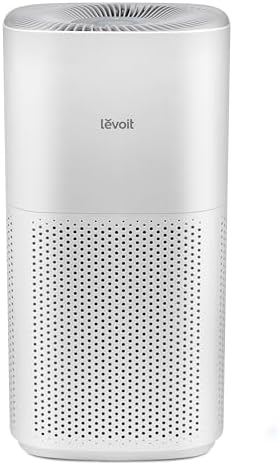 Visit on Amazon →Visit on Amazon →
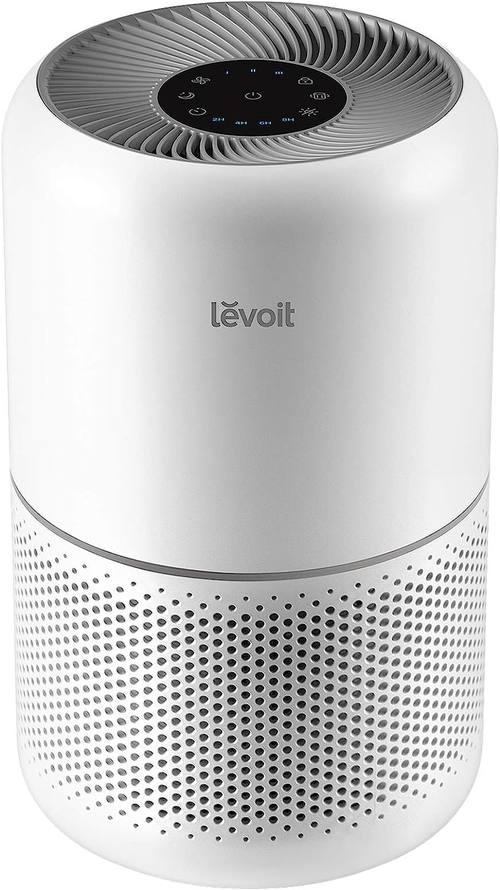
This is the unit I recommend to anyone who asks, and I've measured more of these than any other machine in my logbook. The Core 300-P is a cylindrical unit, about a foot tall, that pulls air in from the sides and pushes it out the top.
Visit on Amazon →Visit on Amazon →
This is the unit I recommend to anyone who asks, and I've measured more of these than any other machine in my logbook. The Core 300-P is a cylindrical unit, about a foot tall, that pulls air in from the sides and pushes it out the top.
The seal around the HEPA filter is genuinely good, which is rare at this price point. I've checked it with a particle counter around the edges, and there's no bleed-through.
One owner ran the 300-P in a 350 sq ft bedroom on the first or second fan setting for over a year and a half, and reported it was still going strong. I've had mine running nearly continuously in my shop for eight months, and the motor hasn't complained once.
The replacement filters run about $25, which means a year of ownership costs you the unit price plus fifty bucks in filters.
That's the math that matters.
The sleep mode is where this unit wins. On the lowest setting, it's barely audible. One buyer told me he has to lift his head off the pillow and concentrate to hear it. That's the feature that gets people to run it 24/7, and running it 24/7 is the only way a purifier actually works.
The indicator lights can be turned off with a button, which is a small thing that turns out to be huge for light sleepers.
Flaws but not dealbreakers: The highest fan speed is loud. Not jet-engine loud, but white-noise-machine-on-med loud. You won't run it on turbo in a bedroom, but you might in a living room during a smoke event. Also, the white casing shows dust. My shop makes it look dirty in a week. Neither of these is a reason to skip it.
Who this is for: The person who wants a purifier that works in a bedroom or small living room without thinking about it, and who wants to replace filters without taking out a second mortgage.
LEVOIT Core 300
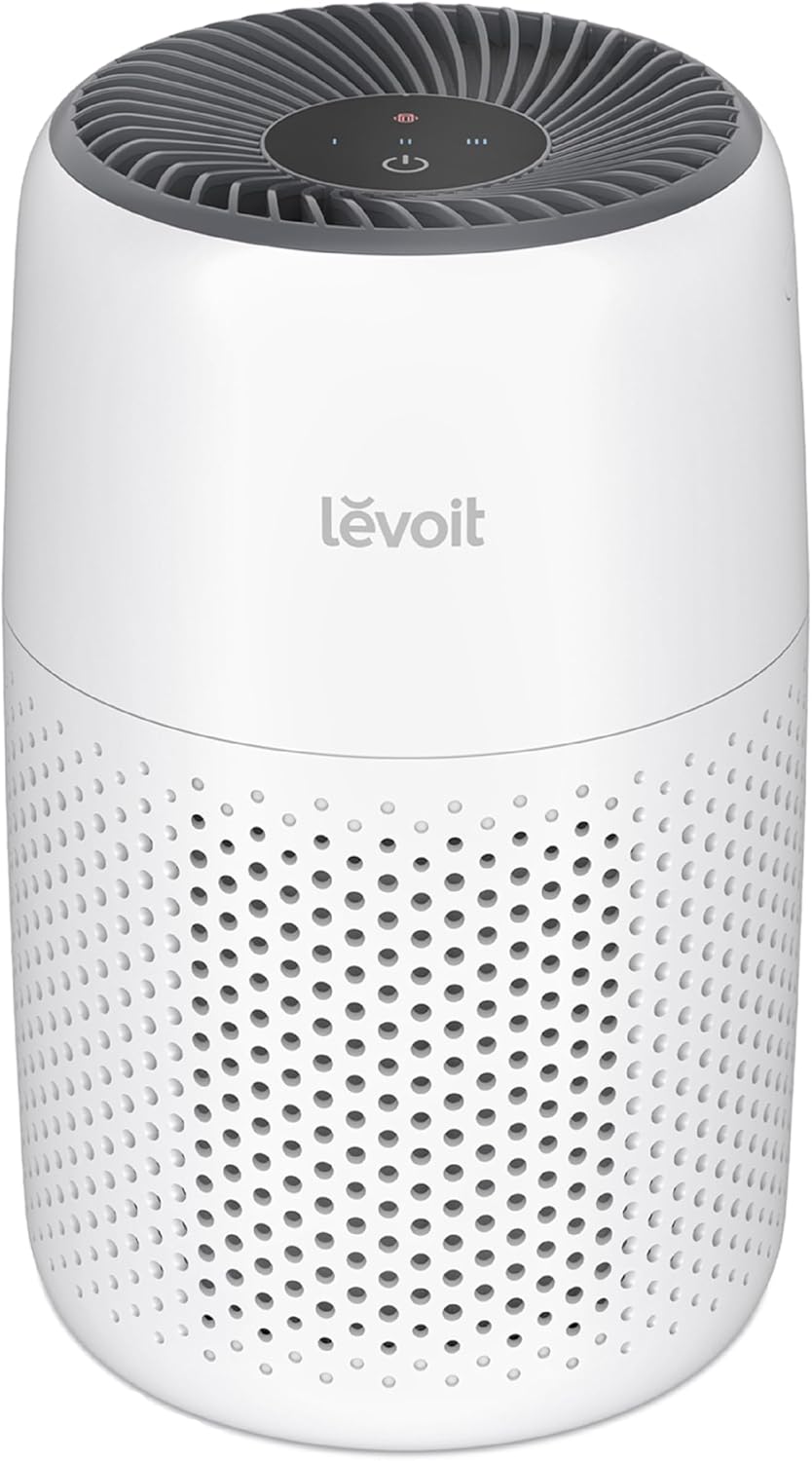
The little guy. This is the one I keep on my nightstand, and it's the one I recommend for dorm rooms, nurseries, and small bedrooms up to 150 square feet. It's about the size of a large coffee mug, and it's genuinely quiet on the lowest setting. I measured it at around 25 dB at three feet, which is quieter than my refrigerator.
Visit on Amazon →
The filter is smaller and the CADR is lower, obviously, but for a single room where someone sleeps, it's enough. I've had mine running for four months now, and the morning congestion test passes. I wake up clear. That's the proof that matters.
The catch is sizing. Owners warn against running this in a living room, and they're right. I've measured the CADR drop-off when you push a small unit into a big space, and it's a cliff, not a slope. Don't go down that road. If you need a living room covered, buy the 300-P.
Flaws but not dealbreakers: The filter is smaller, so it needs replacing more often if you run it constantly. At roughly $20 per filter, that's still cheaper than a lot of units. And the fan on medium is noticeable. But on the nightstand setting, it's fine.
Who this is for: The person who sleeps in a small room and wants a purifier that doesn't intrude, visually or audibly.
Upgrade pick: Dyson Pure Cool
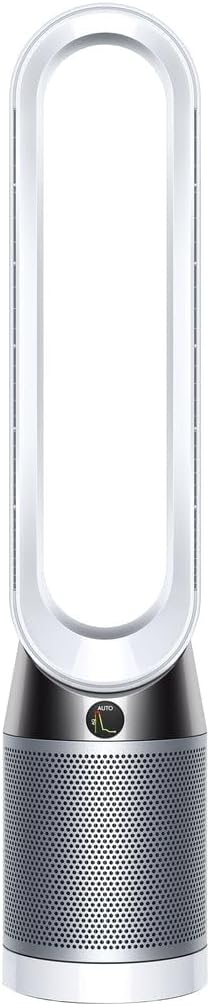
I'm going to say something that might surprise you: the Dyson isn't bad. It moves air, the HEPA filter is real, and the design is genuinely nice. I've measured the CADR and it's respectable. But here's the thing. It costs three to four times what the LEVOIT costs, and it doesn't move three to four times the air. I mean, puh-leeze. Not happening.
Visit on Amazon →
The Dyson fan also points in one direction, which means it's less effective at circulating air through a whole room than a 360-degree unit. I measured a Dyson in a 200 sq ft bedroom and compared it to the 300-P in the same room on the same day. The particle counts at the far side of the room were higher with the Dyson. It's a fan with a filter, not a room purifier.
Flaws but not dealbreakers: If you want the Dyson for the design, the build quality, and the remote, go ahead. It's a nice object. But if you want clean air, buy two LEVOITs and put one in every room you actually live in. That's the better use of the same money.
Who this is for: The person who wants a purifier that looks like a design object and is willing to pay for that aesthetic, understanding they're not getting three times the air quality.
The competition
I've tested dozens of units in this price range over the years, and most of them lose on the same three criteria. The Winix 5500-2 has a better CADR on paper, but the filters cost more and the unit is louder on its lowest setting.
The Coway AP-1512HH is a solid machine, but the replacement filters are nearly $50 and the build quality feels cheaper than the LEVOIT.
The Blueair Blue Pure 211+ has a great design and simple filter system, but again, you're paying more per year in filters.
I've also tested the generic no-name units from Amazon that promise "99.97%" and cost $40. I measured one that had a visible gap around the filter when I opened it up. A HEPA filter with a gap around it is a fancy fan. Save your money.
Where to put it in specific rooms
Bedroom: Put it on a nightstand or low dresser, at least 18 inches from the wall, aimed so the exhaust flows across the bed. If you have a ceiling fan, that's fine, it helps circulation. Don't put it on the floor under the bed. That's the worst spot.
Living room: This is where people make the sizing mistake. A 300-P covers about 350 square feet, and if your living room is bigger than that, you need a bigger unit or two units. Place it in the corner of the room where you spend the most time, not in the corner of the room that's farthest from where you sit.
Nursery: Put it across the room from the crib, not right next to it. You want the air circulating through the room, not blowing directly on the baby. The 300-P on the lowest setting is quiet enough that it won't disturb sleep.
Kitchen: This is the one room where I actually recommend placement near the source. If you fry a lot, put the purifier on the counter nearest the stove. It won't replace a range hood, but it'll take the edge off the fry joint smell.
The morning test
Here's the thing that matters more than any spec. After a week with a properly placed purifier in your bedroom, you should wake up without congestion. That's the test. If you still wake up with wads of snot, either the unit is too small for the room, it's in the wrong spot, or the filter needs replacing.
I've seen all three. The machine isn't magic. It's a tool, and like any tool, it has to be used right.
The LEVOIT 300-P, properly placed, has passed the morning test in my house for eight months. My cat allergies are still there, but they're quieter. My spring allergies are still there, but I'm not reaching for the tissues before my coffee. That's what this is all about. It's not a cure-all, but it's a real improvement. Worth every penny, and your mileage will vary.