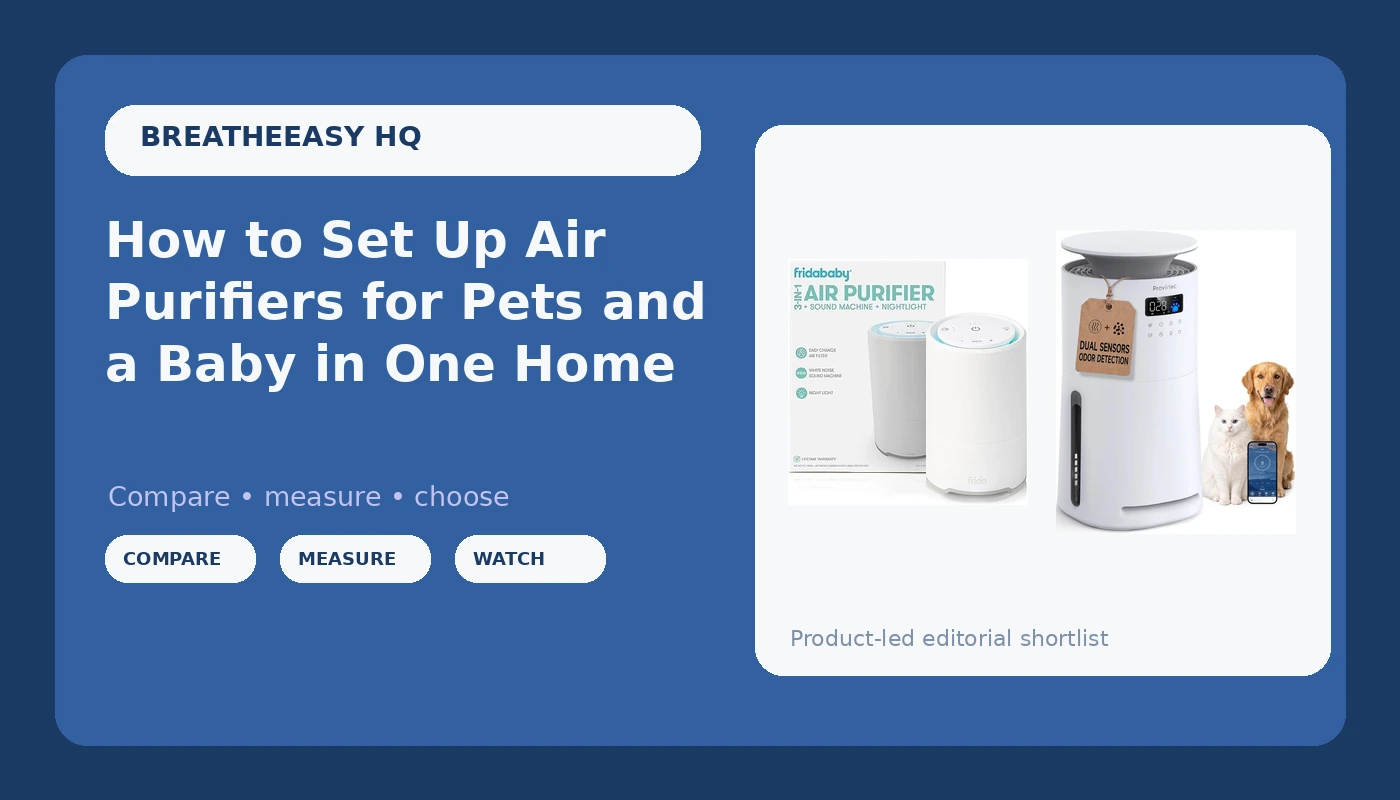
Most people buy an air purifier, plug it in against a wall, and then wonder why the sneezing does not stop. I have watched this play out in hundreds of homes around Portland. A cat owner buys a big box unit, sets it in the corner behind a couch, and the particle count in the middle of the room barely moves. So they buy a second purifier. The problem was never the machine.
A pet and baby air purifier setup is a placement and sizing problem first, and a shopping problem second. Get those two things right and a mid-priced unit outperforms a premium one sitting in the wrong spot. Get them wrong and you have bought a fan with a filter.
This guide covers both halves of a two-purifier house: one unit for the room where the cats sleep and the litter box lives, and one for the nursery where a small person sleeps twelve hours a night. Those are two different jobs and they follow two different sets of rules.
Why you should trust me
I have been an HVAC technician for 14 years, and eight of those years were spent on indoor air quality work: asthma households, wildfire smoke seasons, and mold problems nobody wanted to talk about. I have installed and measured purifiers in real rooms with a real particle counter, not the number printed on the box. I keep a logbook of CADR numbers taken at actual room distances instead of lab conditions, because the two are rarely the same story.
I also live with two cats and a mild allergy to everything that blooms in spring, so I am both the technician and the test subject. When I tell you a purifier belongs on the floor near the source, it is because I have watched my own particle counter prove it in my own living room.
How I picked and what I checked
The gear below is not about which brand wins a spec sheet war. It is about what you point at the air in two very specific rooms. I ran both units through the same four questions I ask about every purifier:
- What is the real CADR at the speed people actually run it, which is medium, not turbo?
- Can I check the filter seal without taking the housing apart with a screwdriver?
- What does the replacement filter cost per year, and is it easy to find?
- Would I install it in a kid's bedroom?
Two units cleared those questions for this particular job, and they clear them for different reasons. One is built around pet odor and particulate sensing. The other is built around a nursery routine, where the purifier has to share the room with a sleeping baby and a tired adult.
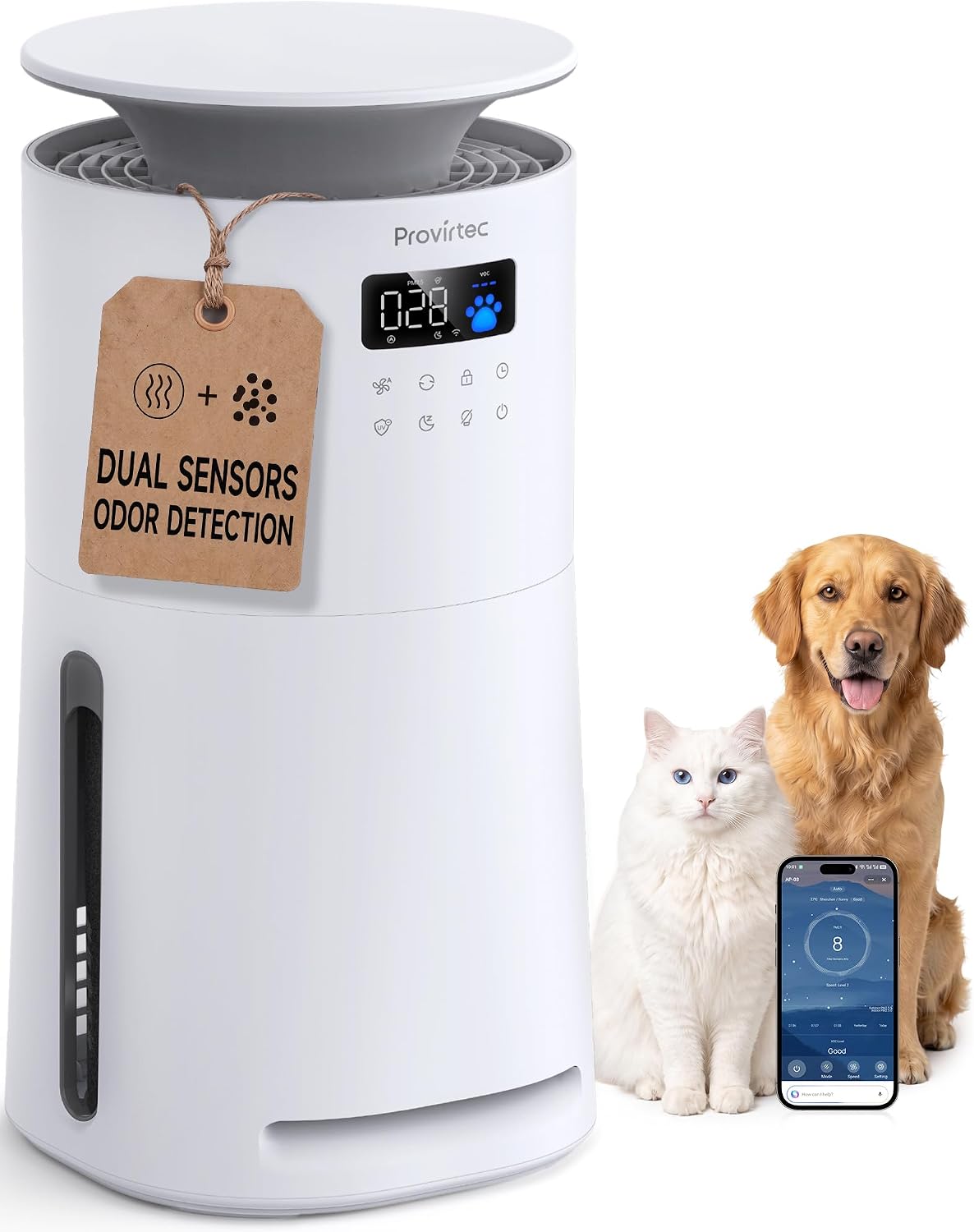
Pet household pick: Provirtec Pet Air Purifier, Odor and PM2.5 Sensors, Dual Air Quality Lights
 Visit on Amazon →
Pet rooms are a two-part air problem. There is the particulate side: dander, dried saliva, tracked litter dust, all of it small enough to hang in the air for hours. Then there is the gas side: ammonia from the litter box, and the general "dog lives here" smell that a plain HEPA stage will not touch because HEPA filters particles, not odors.
The sensor set on this unit is what makes it the pick for that room. An odor sensor plus a PM2.5 sensor means the machine is reading two different things instead of pretending one number covers both. Dual air quality lights mean you can walk past the doorway, glance at it, and know whether the room is trending worse or better without opening an app or leaning over a display.
Placement matters here more than anywhere else in the house. Put it on the floor on the path between the litter box and the door, not in the corner behind the box. Give it a foot of clearance on every side. If you jam the intake against a wall, you have built an expensive white noise machine.
Flaws but not dealbreakers: A sensor-driven auto mode is a convenience, not a substitute for sizing. If the room is too big for the unit, the sensor will just report that the air is bad forever while the fan runs flat out. Sensors also read what they are built to read. An odor sensor is not a VOC lab test, so treat the lights as a trend indicator, not a diagnosis.
Anyone with cats, a dog, or a litter box in a bedroom-sized room will get the most out of this one.
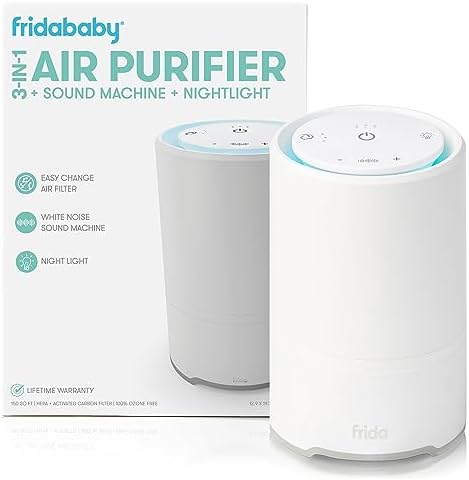
Nursery pick: Frida Baby 3-in-1 Baby Air Purifier for Allergy Relief, Sound Machine for Sleeping + Nightlight, HEPA Filter Purifier for Bedroom with 3 Fan Speeds, Easy-Change Filter, Auto-Off Timer
 Visit on Amazon →
Nurseries have a cord problem. Every device you add to that room is another cord, another outlet, another thing to unplug when the baby starts pulling up on furniture. A 3-in-1 that combines a HEPA purifier, a sound machine, and a nightlight solves a real problem before it starts: one plug instead of three.
The HEPA stage is the reason to buy it. Everything else is quality of life. The sound machine replaces the separate white noise unit you were going to buy anyway, and the nightlight means you are not fumbling for a lamp during a 3 a.m. wake-up. The easy-change filter matters more than it sounds, because the filter is the part you will actually touch for the next three years, and a housing that fights you at 6 a.m. is a housing you stop servicing.
Three fan speeds is the honest number for a bedroom. Low for sleeping, medium for naps and closed-window afternoons, high when someone is sick or the air outside is bad. The auto-off timer is a nice touch for the nights you want it to run for a set window and then stop.
Flaws but not dealbreakers: Three speeds means less granularity than a stepless dial. If you are chasing a specific airflow, you get three choices. Also, a nursery unit is sized for a nursery. If you are pointing this at an open-plan living area, you are asking it to do a job it was not built for, and you will hear about it on high speed.
Anyone who wants one device on the nursery wall instead of three will appreciate what this does.
Sizing the machine to the room
This is the step everyone skips, and it is the reason people end up disappointed. Follow these in order.
Step one: measure the actual room, not the floor plan. Length times width, in feet. If the room has a vaulted ceiling or is open to a hallway, add for that. A "10 by 12 bedroom" that opens into a stairwell is not 120 square feet of air.
Step two: match CADR to the square footage. The working rule is that a purifier's smoke CADR should be at least two thirds of the room's square footage, assuming an eight-foot ceiling. For a pet room or an allergy room, aim higher than the minimum. CADR is the only number that predicts real performance, and if a listing does not publish one, that tells you something.
Step three: check the filter before you check the color. Find the replacement filter for the unit you are considering and confirm it exists, ships, and is priced like a consumable instead of a hostage payment. Filter replacement cost is the real price of the machine. Nobody budgets for it.
Step four: check the seal. On a filter change, look at how the filter sits in the housing. Air should go through the filter, not around it. Bypass is the number one failure on cheap units, and it is invisible unless you look for it.
Step five: run it on medium and listen. If a purifier is quiet on high, it is not moving enough air. Physics does not negotiate. Pick the speed you can live with overnight, and make sure that speed still cleans the room.
Placement rules that matter more than the machine
- Put the unit between the source and the person breathing. In the pet room, that is the litter box to the door. In the nursery, that is the door to the crib.
- Keep a foot of clearance on all sides. Corners kill airflow.
- Set it low. Dander and PM2.5 settle, and the highest concentrations are near the floor.
- Do not put a nursery unit inside a crib tent, behind a glider, or under a shelf.
- Keep cords out of reach and out from under the mattress.
- Do not run a purifier in a closed closet and expect it to clean the room.
- Run it continuously on low rather than in bursts on high. Steady airflow beats intermittent blasting.
The maintenance schedule nobody follows
Every two to four weeks: rinse or vacuum the prefilter. In a pet house this is the single highest-value five minutes you will spend. A clogged prefilter starves the HEPA stage and shortens its life.
Every one to three months: vacuum the intake grille and wipe the sensor ports if the unit has them. Dust on a PM2.5 sensor makes it read high, which makes the auto mode run the fan harder than it needs to.
On the filter schedule: replace the HEPA filter when the manufacturer says, not when it looks gray. A filter that still looks fine can be loaded enough to cut airflow, and airflow is what you actually bought.
At every filter change: check the seal. Re-seat the filter if there is any wobble.
What these two are not
Neither of these replaces source control. If the litter box is not scooped, no purifier on the market fixes that. If the nursery has a mold problem behind the baseboard, a HEPA filter is not remediation. Ventilation, a HEPA vacuum, and washing bedding in hot water all do work that a purifier cannot.
Neither of them is a whole-house solution either. A single portable unit cleans the room it is in and maybe a little beyond it. If you want the whole house handled, that is a different conversation about your HVAC system and a proper filter cabinet, not a second portable unit in the hallway.
And skip anything that advertises ozone. Ozone generators are not air purifiers for occupied rooms, especially not rooms with a baby in them.
What this all costs
Here is the honest math. The purchase price is a one-time number, and it is the number everyone compares. The filter is a subscription you did not plan for, and it is the number that decides whether the machine was a good buy. A cheap purifier with an expensive, hard-to-find filter costs more over three years than a mid-priced one with a filter you can reorder in ten seconds.
So before you buy either unit, check current Amazon price on the purifier and then check the replacement filter listing. If the yearly filter cost looks like a large fraction of the machine, walk away. Electricity is the smallest line item, usually a few dollars a month at low speed.
Add it up over the life of the unit, divide by the days you will own it, and compare that to what you spend on allergy medication in the same window. That is the comparison that matters, and it is the one almost nobody runs.
The short version
Size each unit to the room it will actually sit in. Put it low, near the source, with clearance on all sides. Run it on low around the clock instead of high in bursts. Check the filter seal every time you change the filter, and price the replacement filter before you price the machine.
Do those five things and a pet and baby air purifier setup in one house stops being a guessing game. The machines are not magic. The setup is what you are actually buying.