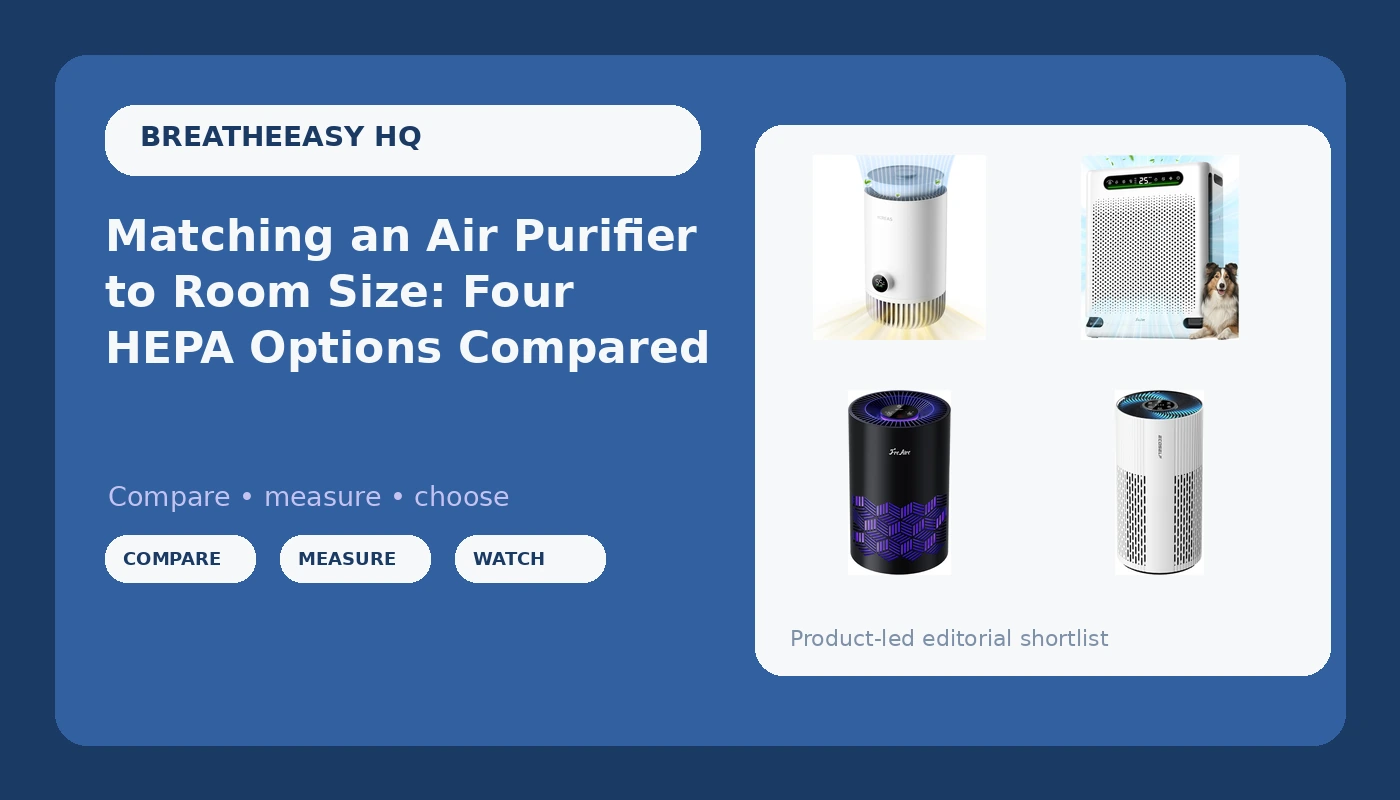
Room size is the first number that decides whether an air purifier does anything for you, and it is the number most buyers skip. A unit sized for a bedroom will not clean a living room, no matter how many fan speeds it offers, and a unit sized for a large room will be louder and bulkier than a small office needs. Getting air purifier room size right is the whole job; filter type, sensor quality, and sleep mode volume are refinements layered on top of it. This explainer covers four current HEPA models, what each one is genuinely built for, and how to match one to your space without paying for capacity you will never use.
Related: How to Check a HEPA Filter Seal →
Quick answer
Match the manufacturer's stated coverage to your room with some headroom, then plan to run the unit one speed below maximum most of the time, because that is where noise and airflow usually balance out. For a bedroom or small office, the compact FreAire KN6391RGB is the right shape and size. For a mid-size bedroom or an open living area, the HAP604's 1500 square foot rating is the practical middle. For the largest open spaces, the HAP605 carries the highest stated coverage of the four plus a real-time PM2.5 readout. The humidifier and purifier combo is the right choice only when dry air is part of the problem, since it adds a water tank you have to fill and maintain.
4 useful options
| Model | Best fit | What stands out |
|---|---|---|
| FreAire Air Purifiers for Home Large Room Up to 2600 Ft², HAP605, White | HEPA Air Purifier with Washable Filter and Real-Time PM2.5 Display, 20 dB Sleep Mode, Turbo Mode for Pet Hair, Dust & Smoke | Largest open living spaces | Highest stated coverage in this group, washable filter, real-time PM2.5 display, turbo mode |
| Air Purifiers for Home Large Room Up to 1500 Ft², True HEPA Filter, HAP604 | 20dB Sleep Mode, 360° Air Intake & Outlet, Night Light, Timer Settings, Air Cleaner for Bedroom, Pet Dander & Smoke, White | Mid-size rooms and open bedrooms | True HEPA filtration with 360 degree intake and outlet, timer, night light |
| FreAire Air Purifiers for Bedroom Up to 1086 Ft², KN6391RGB, Black | Bedrooms and small offices | Compact black housing, stated coverage up to 1086 square feet |
| Humidifier & Air Purifier Combo, 0.8-Gal Top Fill | Dry rooms that also need particle filtration | Adds a 0.8 gallon top-fill humidifier to air cleaning |
Largest coverage: the FreAire HAP605
The trade-off with a large-room unit is that you are buying airflow you may not need. In a small bedroom this model will spend its life on low, which is fine, but you paid for the top of the range. Where the extra capacity earns its place is an open-plan space where the purifier sits in one corner and the kitchen is thirty feet away, because that is the situation where a bigger machine actually changes what a sensor reads. The washable filter stage matters here too: a rinseable first stage catches hair and lint before it reaches the HEPA media, and that is what determines how often you buy a replacement.
The mid-size middle: the HAP604
This is the model to look at when a single room is the target and you want the intake to work from any direction. A 360 degree intake and outlet means the unit does not need a clear wall in front of it, which helps in the middle of a bedroom where furniture crowds the perimeter. The timer is a small feature that changes habits more than people expect, because it lets you run the unit hard while you are out of the room and let it settle before you come back. As with any coverage figure, the 1500 square foot number assumes the highest fan speed in a closed room with an eight-foot ceiling, so a room with an open doorway or a vaulted ceiling will want more margin.
Bedroom and small room: the FreAire KN6391RGB
A single-room unit is the most common purchase mistake in reverse. People buy a small purifier for a large room and wonder why nothing changes, and they also buy a large purifier for a small room and wonder why it is loud. If your goal is a bedroom that smells neutral when you wake up, a unit sized to that one room will run at a lower speed and therefore a lower noise level for the same result. The catch is that a smaller machine has less margin, so placement matters more: keep it off the floor, away from the curtain, and out of the corner where air cannot circulate back to the intake.
When dry air is part of the problem: the humidifier combo
A combo unit solves a real problem for people who live in dry climates or run heat all winter, where the complaint is a scratchy throat in the morning rather than visible dust. It also introduces maintenance that a plain purifier does not have: a tank to fill, a wick or evaporator surface that can develop odor if it sits wet, and a routine you have to keep up with. If your issue is purely particles, the humidification is dead weight. If your issue is winter dryness plus dust, one footprint beats two appliances fighting for the same outlet.
Prices and availability may change. Product images, names, and retailer links are matched to verified listings. No current price, rating, stock status, or measured result is stated here without current evidence.
What a coverage rating really tells you
Every purifier box carries a square-footage number, and almost nobody explains where it comes from. The number is derived from the unit's clean air delivery rate, the volume of clean air it moves per minute, against an assumption about how many times per hour the air in the room should be turned over. Most manufacturers assume an eight-foot ceiling, a closed room, and the machine running at its highest fan speed. Change any one of those and real coverage drops.
The working rule of thumb in the industry is that a purifier's clean air delivery rate, in cubic feet per minute, should be roughly two thirds of the room's square footage for a typical residential turnover target. A 300 square foot room wants something in the neighborhood of 200 CFM on the setting you actually use. That matters because the box rating is usually measured at maximum. If you plan to sleep with the unit on low, the room it can genuinely clean shrinks, sometimes by half.
A few other assumptions are baked into every coverage figure. Open doorways let treated air escape and untreated air wander in. Vaulted ceilings add volume that the square-footage number ignores entirely. Furniture that blocks airflow reduces how much of the room the unit ever reaches, and so does pushing the intake against a curtain or a wall. Treat the stated number as a ceiling rather than a target, and buy a size that leaves you margin. Oversizing slightly costs a little more up front and lets you run at a lower, quieter speed for the same result.
The features that decide how the machine feels after a month
Washable filter stage. A rinseable prefilter catches pet hair, lint, and coarse dust before it reaches the HEPA media. On units that have one, you rinse it monthly and the expensive filter lasts longer. On units that do not, the HEPA stage absorbs that load and you replace it sooner. This is the most underrated spec in the category.
PM2.5 display versus a generic air quality score. A real-time PM2.5 readout shows the particle concentration the sensor is reading, in micrograms per cubic meter. A color-coded air quality index condenses that into a light. The number is more useful because you can watch it fall when you turn the unit up, which tells you the machine is doing something and the sensor is not just guessing.
Sleep mode and decibels. A sleep mode is only meaningful if it comes with a decibel figure. A unit listed at 20 dB on sleep is quiet enough for most bedrooms. What matters more is what happens when you raise the speed, because airflow and noise are physically linked. If a purifier stays silent at its highest setting, it is not moving much air.
Intake geometry. A 360 degree intake and outlet pulls from every direction, which helps when the unit sits in the middle of a room. A single-side intake needs clear space in front of it, and it will starve if you tuck it behind a sofa.
Humidification. Adding a humidifier means adding a water tank, a wick or evaporator to maintain, and a fill routine. It helps in dry air and does nothing for particles, so choose a combo only when you want both functions in one footprint.
A five-step way to choose
- Measure the room in square feet, including any open space the air can drift into through a doorway or stairwell.
- Compare that number to the stated coverage, then discount it, because the rating assumes maximum fan speed in a closed room.
- Decide how loud the unit can be while you sleep, and check whether the sleep mode figure is listed in decibels rather than described in words.
- Look at the filter setup. A washable stage extends the life of the HEPA filter, which is where the ongoing cost lives.
- Check the price and availability of the replacement filter for the exact model before you order the machine, because that is the real cost of ownership.
Practical notes before you order
- Put the unit where air can reach the intake from at least two directions, not flat against a wall or behind furniture.
- Run it continuously on a medium setting rather than blasting turbo in short bursts, since steady turnover beats intermittent cleaning.
- Rinse or vacuum the prefilter stage monthly if you have pets, because hair load is what kills HEPA filter life fastest.
- Keep the unit off the floor in high-traffic rooms, where footfall keeps coarse dust suspended near the intake.
- Confirm the replacement filter for your specific model is stocked and reasonably priced before you commit, and set a reminder for the swap.
Which option should you choose?
Choose the FreAire Air Purifiers for Home Large Room Up to 2600 Ft², HAP605 when you are cleaning an open-plan living space and want the highest stated coverage in this group, a washable filter stage, and a PM2.5 readout you can watch in real time. Choose the Air Purifiers for Home Large Room Up to 1500 Ft², True HEPA Filter, HAP604 when a mid-size bedroom or living room is the target and you want true HEPA filtration with a 360 degree intake, a timer, and a night light. Choose the FreAire Air Purifiers for Bedroom Up to 1086 Ft², KN6391RGB when you are treating one bedroom or small office and want a compact, dark-housed unit that can run at a lower, quieter speed for that room size. Choose the Humidifier & Air Purifier Combo, 0.8-Gal Top Fill when winter dryness is as much of a complaint as dust, and you would rather fill one tank than run two appliances.
One caveat applies to all four: the coverage figures quoted here are the manufacturers' stated ratings, not independent measurements, and they assume a closed room with a standard ceiling and the unit at maximum speed. No decibel reading, airflow measurement, or filter-life figure in this article was independently verified, and none should be treated as a lab result. Check the current listing for your chosen model, and confirm the replacement filter price and availability before you buy.
The bottom line
Room size decides everything else. Pick a unit whose stated coverage comfortably exceeds your actual room, plan to run it a speed or two below maximum, and budget for filters from day one, because the filter is where the money goes over a few years. For most single rooms, the compact FreAire KN6391RGB is the sensible size. For a mid-size space, the HAP604's true HEPA filter and 360 degree intake cover the practical middle. For the largest open areas, the HAP605 offers the most stated capacity here along with a washable filter and a live PM2.5 readout. And if dry air is part of your complaint, the humidifier and purifier combo addresses both problems in one footprint. Check current Amazon price and filter availability on whichever model matches your room before you commit.