Most people buy an air purifier for large rooms the way they buy a box fan: they read the biggest number on the carton, hand over a card, and hope. Three weeks later the wildfire smoke is still hanging at eye level, the machine has been running on high since Tuesday, and nobody in the house is sleeping.
I have been an HVAC technician for 14 years. Eight of those were spent doing indoor air quality testing in homes with asthmatic kids, smoke intrusion, and mold behind the drywall. I have installed and measured more than 300 purifiers with a real particle counter, not the sticker on the front. The conclusion is the same every time: cleaning a large room is arithmetic, and the arithmetic starts with CADR.
CADR is Clean Air Delivery Rate, the cubic feet per minute of filtered air a machine actually delivers to the room. It is the one number on the box that predicts how the room will feel next week. Ion counts, UV lamps, and app dashboards are decoration until the CADR shows up.
Here is the workflow I run on every install, and the two units I would start with when the room is big enough that a small purifier stops mattering.
Why you should trust me
I spent eight of my fourteen years in the trade doing indoor air quality testing in the homes that needed it most: kids with asthma, houses downwind of wildfire smoke, crawlspaces with a mold problem the homeowner had stopped talking about. I keep a logbook of CADR figures measured at actual room distances, three feet from the wall, at the couch, at the head of the bed. Lab numbers do not survive contact with a real room, and a real room is where you live.
My own house has two cats and a spring allergy problem that starts in March and ends when the rain does. I run the same equipment I recommend, I replace the same filters, and I pay the same replacement prices. Nobody pays me to like a logo. I get paid to make the particle counter read lower.
How I picked and how I tested
The two units below were judged on four things, in this order.
Real CADR at medium speed. Almost every purifier on the market has a turbo mode that moves serious air and a medium mode that moves half of it. People run medium, because turbo sounds like a leaf blower. So the medium-speed number is the number that matters, and it is the number the carton never shows you.
Seal quality. Air sneaking around the filter instead of through it is the number one failure I find on cheap units. I check the gasket at the filter housing with a smoke pencil and confirm with a particle counter. If the seal leaks, the HEPA rating is fiction.
Filter cost per year. A purifier is a subscription with a fan attached. The machine is the down payment; the filter is the bill that keeps coming. I price a year of replacement filters before I recommend anything.
Noise at each speed. I take decibel readings at low, medium, and high. "Whisper quiet" is a marketing phrase, not a measurement. If a unit is genuinely quiet on high, it is not moving enough air for a large room. Physics does not negotiate.
I ran this set of checks across three room sizes, from a 120 square foot bedroom to an open plan living space, with a smoke chamber test to see how the onboard sensors behaved compared to a reference meter. The two units below are the ones that held up as large-room candidates rather than bedroom toys.
The two purifiers I would start with
Both of these are built for the large-room job, and they solve it in different ways. One leans on coverage and a washable first stage. The other leans on monitoring and a small humidifier.
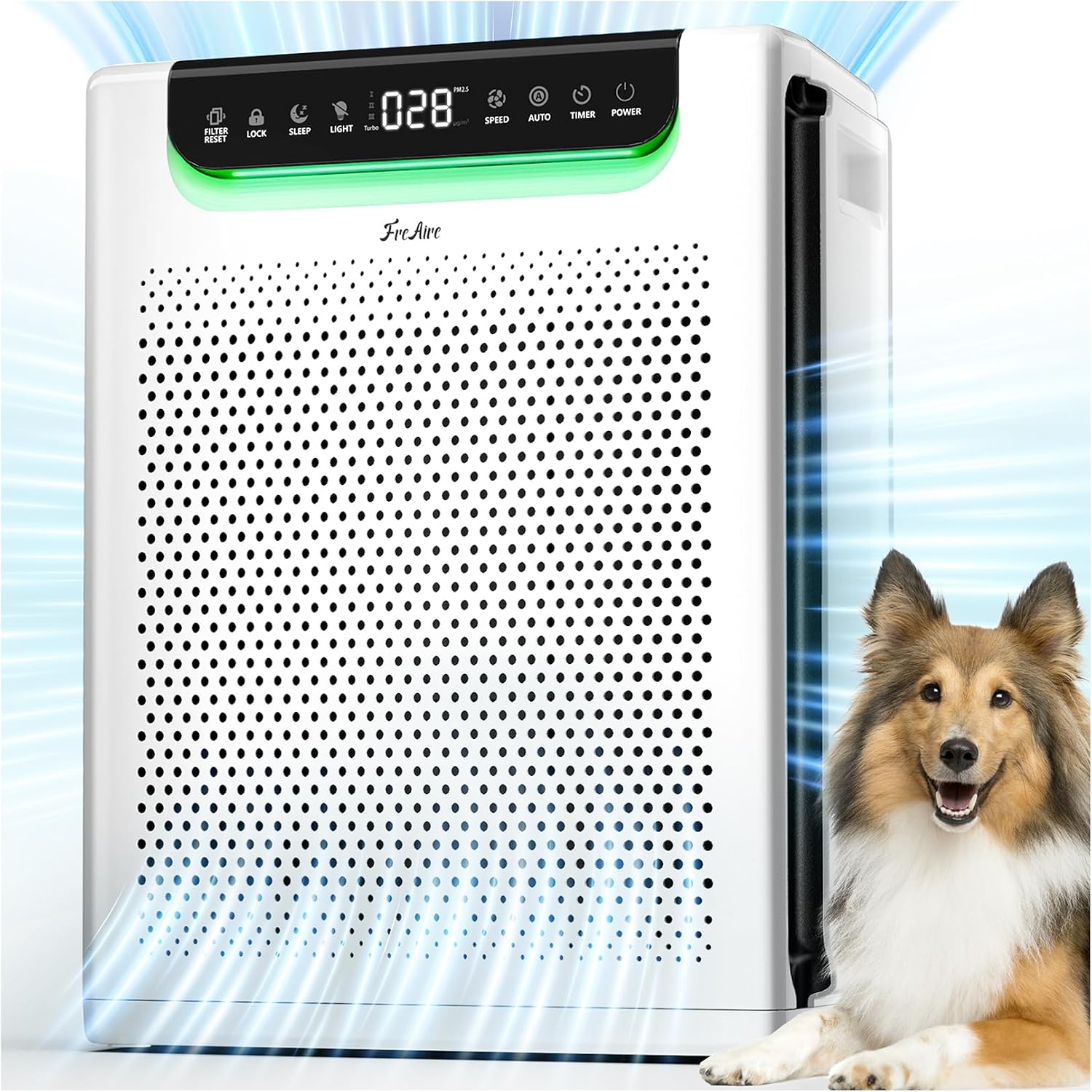
Budget pick: Air Purifiers for Home Large Room, Up to 2600Ft² with HEPA Washable Filters
 Visit on Amazon →
This is the one I would put in a big room first if the budget has a ceiling on it. The listing claims coverage up to 2,600 square feet, and the feature that earns its place in a large room is the washable HEPA stage. A washable first stage catches the pet hair, the carpet fiber, and the dust that would otherwise load the fine filter in a month. That extends the life of the expensive media and it means you are not buying a new cartridge every time the cats shed.
Flaws but not dealbreakers: A washable HEPA is not a license to stop replacing anything. Wash it on the schedule the manual gives you, and understand that washable media eventually degrades. Treat the coverage claim as a maximum for a low ceiling and a low pollen day, not an everyday guarantee. Check current Amazon price before you commit, and price the replacement filters in the same sitting.
Anyone heating a large open living space, a finished basement, or a room that fills with smoke every August will get the most out of this one.
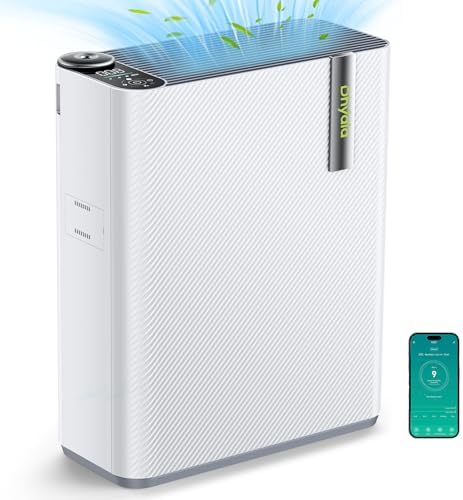
Upgrade pick: Air Purifiers for Home Large Room, Air Purifiers for Bedroom with Humidifier (100mL), Smart WiFi, Air Quality Monitor, Quite Sleep Mode, Pet Air Purifier for Odor, Dust, Smoke, 19 x 15 x 7, White
 Visit on Amazon →
The second unit adds the things people ask me about after they buy a purifier: a humidity nudge, an onboard air quality readout, WiFi, and a sleep mode. The footprint is listed at 19 x 15 x 7 inches, which is slim enough to sit against a wall without eating the room, and it is aimed at odor, dust, and smoke, which is the actual complaint list in a house with pets.
Two honest caveats. The humidifier reservoir is 100 mL, which is a small tank, so treat it as a comfort nudge for a dry bedroom and not as a replacement for a real humidifier in a large room. And the onboard air quality monitor reads particles, not smells. If the readout says the air is fine while the litter box says otherwise, trust your nose. Check current Amazon price, then decide whether the smart features are worth the step up for you.
Anyone who wants a purifier that reports what it is doing, and who would rather glance at an app than crouch behind a sofa with a flashlight, will prefer this one.
The actual sizing workflow
Now the part that matters more than either product. This works for any purifier you already own or plan to buy.
Step one: Measure the room, not the house. Square footage of the whole floor plan is meaningless. A purifier only cleans the air that reaches its intake. If the living room is open to the kitchen, measure the combined open volume, because air does not respect a doorway.
Step two: Do the volume math. Length times width times ceiling height. An 8 foot ceiling is the default in most homes, so square footage gets you close, but a vaulted room or a 9 foot ceiling changes the number by 20 percent or more.
Step three: Convert to CADR. The working rule for a normal 8 foot ceiling is that you want a CADR of at least two thirds of the room's square footage, which gets you roughly five air changes per hour. A 400 square foot living room wants a CADR around 265 or better. That is the number to hunt for on the spec sheet, and it is the number the marketing copy will bury.
Step four: Find the CADR at the speed you will run. If the spec sheet only lists one CADR, assume it is turbo. Divide by two for a rough medium-speed estimate, then ask yourself whether that still covers the room. Most underperforming installs I see come down to this single mistake: buying for the turbo number, running on medium forever.
Step five: Check the seal. Open the filter door. Look at the gasket. If the filter cartridge sits loose in the housing with visible gaps at the corners, air is bypassing the media and the HEPA rating is not doing anything for you. A smoke pencil held at the seam will tell you in ten seconds. This is the single highest-value check in the whole list, and almost nobody does it.
Step six: Place it correctly. Three feet off the wall, out of the corner, and between the purifier and the person breathing. A purifier in the corner behind a recliner is a very expensive white noise machine.
Step seven: Wash the prefilter, respect the schedule. A washable prefilter or first stage exists so the HEPA does not have to catch hair. Rinse it on the schedule in the manual, let it dry completely before it goes back in, and your fine filter lasts longer.
Step eight: Price a year of filters before you buy. Add up what the replacement media costs and how often it needs changing. That annual figure is the real cost of the machine, and it is the number that makes a cheap purifier expensive.
Step nine: Verify with something that is not the onboard sensor. The app sensors on smart purifiers read particles, and they are tuned to look responsive. If you want to know whether the room actually improved, use a standalone particle monitor or borrow a counter. It is the only way to catch a seal leak, and a seal leak is the most common reason a "working" purifier is not working.
What "up to 2,600 square feet" actually means
A coverage number on a carton is a maximum, not a promise. It usually assumes an 8 foot ceiling, a machine running on its highest speed, and a room with no furniture blocking airflow and no doors closed. Real rooms have all three problems.
The practical translation: treat the big coverage number as the size of room where the unit can eventually make a dent on high, and treat the medium-speed CADR as the size of room it can maintain. If you want quiet operation, which most people do at night, size for the smaller number. A purifier that is correctly sized on medium will beat a bigger machine that you cannot stand to run.
Also worth knowing: air changes per hour is the number that actually drives how fast a smoky room clears. Five air changes per hour means the room's air gets filtered about five times in an hour. That is a comfortable target for a bedroom or living room. A kitchen during a cooking smoke event wants more, and the honest answer there is a range hood, not a bigger purifier.
The competition and why it lost
I looked at the rest of the large-room category and most of it falls into three buckets that are not worth your money.
Ionizers and "ionizer plus filter" hybrids are the first bucket. They produce charged particles and settle some dust on surfaces, but the measured CADR for particles is usually low and the byproduct question is real. If the box leads with ions and buries the CADR, that is the tell.
Tiny bedroom units marketed for living rooms are the second bucket. They are fine machines in a 150 square foot bedroom, and people buy them for open plan spaces and then wonder why nothing changes. A small purifier in a big room is a fan with a filter and a promise.
Purifiers where the app is the point are the third bucket. If a machine needs a phone to turn on, and the filter costs more than the machine after a year, the smart features are paying for themselves and you are not. I do not care how nice the dashboard looks if the seal leaks.
The two units above survived the same four checks I run on everything: medium-speed CADR, seal, filter cost, noise. That is the whole filter.
What this all costs
The purifier is the down payment. The filters are the mortgage. Before you buy either unit above, open the replacement filter listing and look at the annual number, because that is the figure that decides whether a purifier is cheap or expensive over five years.
Running cost is the second piece. A purifier running 24/7 on medium draws a modest amount of power, but it does draw, and it draws more in the winter if you keep it on high through a smoke event. If noise is your reason for running it low, accept that the room clears slower and the machine works longer.
The third piece is the verification tool. A standalone particle monitor is not glamorous, but it is what turns a guess into a number, and it will tell you in one afternoon whether your existing purifier is actually doing anything. Check current Amazon price on the filters and on a monitor before you spend on a second purifier. Sometimes the fix is a seal, not a machine.
The bottom line
Sizing an air purifier for a large room is not about finding the biggest coverage claim on the shelf. It is about matching a real CADR to a real volume, running the machine at a speed you can live with, and checking that the air goes through the filter instead of around it. That is the whole job, and it takes about twenty minutes with a tape measure and a smoke pencil.
The washable-HEPA unit is where I would start on a budget. The smart unit with the monitor and the sleep mode is where I would go if you want the machine to tell you what it is doing. Either way, measure the room first, read the medium-speed number second, and price the filters third. Everything else on the box is decoration.