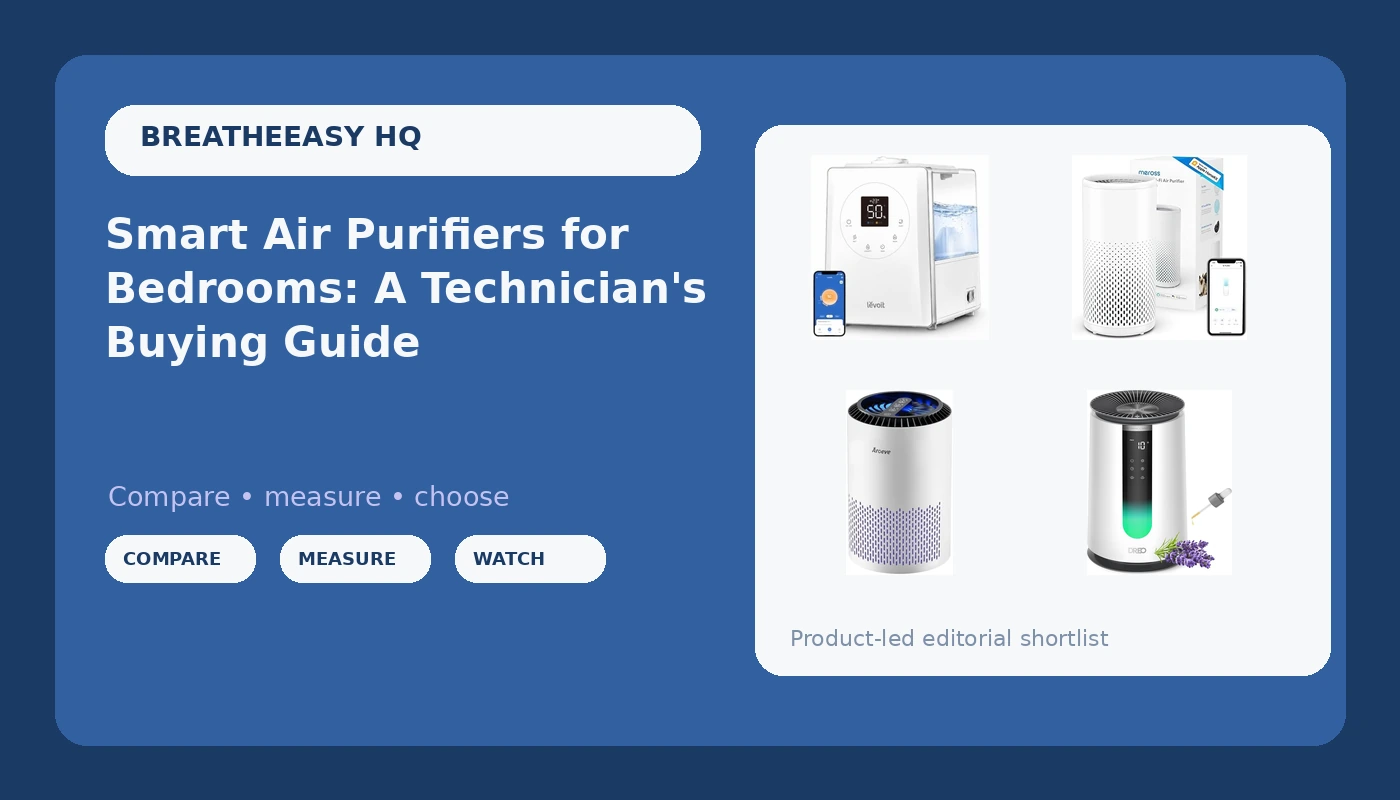
Most people shop for a bedroom purifier the way they shop for a fan. They read the box, see a percentage, and hope. Then the unit runs all night and the morning congestion does not change. The filter material is almost never the problem. Either the machine moves less clean air than the room needs, or the air sneaks around the filter instead of through it. This guide explains how to evaluate smart air purifiers for bedrooms, which numbers deserve your attention, and which of four current options fits which kind of room. One of the four is not a purifier at all, and it earns its place for a different reason.
Related: How to Size an Air Purifier for a Room →
Quick answer
Match the machine's clean air delivery rate to the room's floor area first, then check the seal around the filter and the yearly cost of replacements. Everything else, including app control and sensor displays, is secondary. Among the four options here, the DREO Air Purifier for Home carries the most verifiable performance framing, with an AHAM VERIFIDE listing, a PM2.5 monitor, and both auto and turbo modes. The meross Smart WiFi Air Purifier is the one to look at if your household already runs on Apple HomeKit. The AROEVE MK01A suits a simple small-room setup with no smart features to manage. The Levoit LV600S handles humidity rather than particles, which matters if your bedroom air is dry as well as dirty.
Four useful options
| Model | Best fit | What stands out |
|---|---|---|
| DREO Air Purifier for Home, HEPA Sleep Mode, AHAM VERIFIDE Air Purifiers for Bedroom, Pets, Smoke, Dust, Pollen & Odors, PM2.5 Monitor, Auto & Turbo Mode, 4 Speeds, Scent Diffuser, DR-HAP008(Dreo 338) | Bedrooms that need automatic response to particle spikes | AHAM VERIFIDE listing, PM2.5 monitor, auto and turbo modes, four speeds, scent diffuser |
| meross Smart WiFi Air Purifier for Home Supports Apple HomeKit, Alexa, Google Home and SmartThings, H13 True HEPA Filter 24dB Quiet Air Purifier, Pets, Smoke, Dust, Pollen, 2.4G Only | Homes already built around HomeKit, Alexa, Google Home, or SmartThings | H13 True HEPA filter, four-platform smart home support, manufacturer-stated 24 dB operation, 2.4 GHz Wi-Fi only |
| AROEVE Air Purifiers for Bedroom with Sleep Mode Speed Control-MK01A(White) | Small bedrooms and no-app operation | Sleep mode, speed control, compact white housing |
| Levoit LV600S Smart Warm&Cool Mist Humidifiers for Home Bedroom Large Room | Bedrooms that are dry and need humidity rather than filtration | Smart warm and cool mist output for large rooms |
The measurement-first pick: DREO Air Purifier for Home
The reason the verification matters is simple. A purifier's real job is to push a measured volume of filtered air into a room every minute, and that figure is what tells you whether the machine can keep up with a closed bedroom door, two cats, and a wildfire smoke week. A sensor-driven auto mode is genuinely useful here, because it lets the unit ramp up when particle counts climb instead of making you guess. The trade-off is that auto mode only responds to what its sensor detects. Most built-in sensors read particulate matter, not smells, so cooking odors or pet litter will not necessarily trigger a speed change. The turbo setting is the manual override for those moments. If you want one unit that combines documented performance with automatic behavior, this is the one to size against your room first.
The connected pick: meross Smart WiFi Air Purifier
Two details are worth slowing down on. The first is the 2.4 GHz requirement. If your router splits its bands and your phone is parked on the 5 GHz network, setup can stall before you ever reach the purifier's controls. That is a network issue, not a defect, but it is the most common reason a connected purifier gets returned. The second is the decibel figure. A 24 dB rating is a manufacturer claim and it describes a specific speed, usually the lowest one. A purifier that stays whisper-quiet on its top setting is not moving much air, because fan noise and airflow travel together. Treat any low noise number as a description of the quiet mode, then decide whether that quiet mode is the speed you will actually run overnight. For a HomeKit household that wants air cleaning triggered by scenes and schedules, this is the sensible choice.
The simple bedroom pick: AROEVE Air Purifiers for Bedroom
The case for a machine like this is reliability and simplicity. Nothing about it depends on a cloud service, a firmware update, or a router band, and there is no sensor to drift out of calibration. The trade-off runs in the other direction too. Without a particle sensor, the unit cannot ramp itself up when smoke rolls into the neighborhood, so you have to notice and turn the dial yourself. Without a stated smart platform, you cannot schedule it through HomeKit or Alexa. What remains is a straightforward bedroom appliance that does one thing. If your room is on the smaller side and you want to set a speed and forget it, that simplicity is a feature rather than a compromise.
The humidity companion: Levoit LV600S
Dry air and dirty air produce overlapping symptoms, which is why people confuse the two. A dry bedroom dries out nasal passages, and irritated passages react more strongly to the same particle load. Adding humidity can make a room feel dramatically better without changing the particle count at all. That is why this belongs in a conversation about bedroom air even though it is not filtration. Two cautions come with it. First, humidifiers need regular cleaning, because standing water and mineral scale create their own indoor air problems. Second, more humidity is not automatically better. Overshooting into a damp room invites dust mites and mold, which is the opposite of what you wanted. If your bedroom is both dry and dusty, the honest answer is that these are two machines doing two jobs.
Prices and availability may change. Product images, names, and retailer links are matched to verified listings. No current price, rating, stock status, or measured result is stated here without current evidence.
Why clean air delivery rate is the number to check first
Clean air delivery rate, usually shortened to CADR, is the volume of filtered air a purifier delivers per minute, expressed in cubic feet per minute. It is the closest thing this category has to an honest specification, because it combines airflow and filtration efficiency into one figure. A high-efficiency filter on a weak fan scores poorly. A strong fan with a leaky filter also scores poorly. Only the combination produces a real number.
The practical rule of thumb is to look for a CADR roughly two-thirds of your room's floor area in square feet, then adjust upward for smoke, pets, or allergies. A 150 square foot bedroom points toward a CADR around 100 cubic feet per minute as a floor, not a ceiling. Two things routinely get hidden in that math. First, published figures are often taken at the highest speed, and most people run a purifier on medium overnight. Ask what the number looks like at the speed you will actually use. Second, a percentage removal claim tells you nothing about speed. Removing 99.97 percent of particles eventually is easy; the question is how long the machine takes to cycle the room. If a listing gives you a percentage and no CADR, you have marketing, not a specification.
Seal quality, filter cost, and the app question
Bypass is the failure nobody photographs. If the filter sits loosely in its housing, or if the gasket is thin, or if the filter frame warps, air takes the path of least resistance and flows around the media instead of through it. The machine still sounds like it is working. The particle count barely moves. When a unit is easy to open, look for a gasket, a locking frame, and a snug fit with no visible gap at the edges.
Filter cost is the other number people skip. The purchase price is a down payment; the real cost is the replacement cadence over three years. A cheap machine with expensive filters can cost more than a mid-priced one with reasonably priced media, and a washable prefilter changes that math by catching hair and dust before they reach the HEPA stage.
- Measure the room in feet, including ceiling height, and write down the floor area.
- Set a CADR target at roughly two-thirds of the floor area, then raise it for smoke, pets, or allergies.
- Check the seal: gasket present, filter locked, no gaps around the frame.
- Price replacement filters for year one and year three before you commit.
- Decide whether you want app control at all, and if you do, confirm your network runs a 2.4 GHz band.
Practical guidance for bedroom use
- Give the unit at least a foot of clearance on all sides so it is not pulling air off a wall.
- Run medium for daily use and save the top speed for smoke events, cooking, and vacuuming.
- Clean or rinse the prefilter on a schedule so the HEPA stage is not doing the prefilter's job.
- Keep windows closed during wildfire smoke and run the purifier continuously rather than in bursts.
- Treat humidity as a separate decision, and keep the room from swinging into damp territory.
Which option should you choose?
Choose the DREO Air Purifier for Home, HEPA Sleep Mode, AHAM VERIFIDE Air Purifiers for Bedroom, Pets, Smoke, Dust, Pollen & Odors, PM2.5 Monitor, Auto & Turbo Mode, 4 Speeds, Scent Diffuser, DR-HAP008(Dreo 338) when you want a documented performance listing, a particle sensor, and automatic speed changes in a room sized to match its rating. Choose the meross Smart WiFi Air Purifier for Home Supports Apple HomeKit, Alexa, Google Home and SmartThings, H13 True HEPA Filter 24dB Quiet Air Purifier, Pets, Smoke, Dust, Pollen, 2.4G Only when your household already runs on HomeKit, Alexa, Google Home, or SmartThings and you want cleaning folded into routines. Choose the AROEVE Air Purifiers for Bedroom with Sleep Mode Speed Control-MK01A(White) when the room is small, the budget is tight, and you would rather press a button than open an app. Choose the Levoit LV600S Smart Warm&Cool Mist Humidifiers for Home Bedroom Large Room when the air in the room is dry and you have already handled the particle side of the problem.
One caveat applies to all four. Nothing here substitutes for matching a machine to your actual room size, and no listing can tell you how a unit behaves in your house. The features described above come from the product listings themselves, not from independent measurements taken in your space or mine.
The bottom line
Buy the number, not the badge. Size the machine to the room using clean air delivery rate, confirm that the filter seals properly, and count the replacement filters into the total cost before you check out. The DREO Air Purifier for Home is the strongest starting point for most bedrooms because its AHAM VERIFIDE listing gives you something external to check, and its sensor and auto mode handle the moments when you are not paying attention. The meross unit is the right call for smart-home households, the AROEVE MK01A is the low-friction option for a small room, and the Levoit LV600S belongs in the conversation only if dry air is your actual complaint. Get the sizing right and any of these will outperform a larger machine that never gets turned on.