Room coverage numbers are the easiest thing to shop by and the least reliable thing to trust. A listing that claims 1,875 square feet and one that claims 880 square feet are not describing the same measurement, and neither figure tells you how much clean air the machine moves per minute at the speed you will actually run it. If you are comparing smart air purifiers for large rooms, start with CADR and treat the square-foot number as a rough ceiling rather than a promise.
This is an explainer, not a scoreboard. Four units are on the table, each with a different coverage claim and a different feature set. The goal is to show you which specs to check, in what order, so you can match one to your room instead of guessing from a photo and a badge.
Related: How to Size an Air Purifier for a Bedroom →
Quick answer
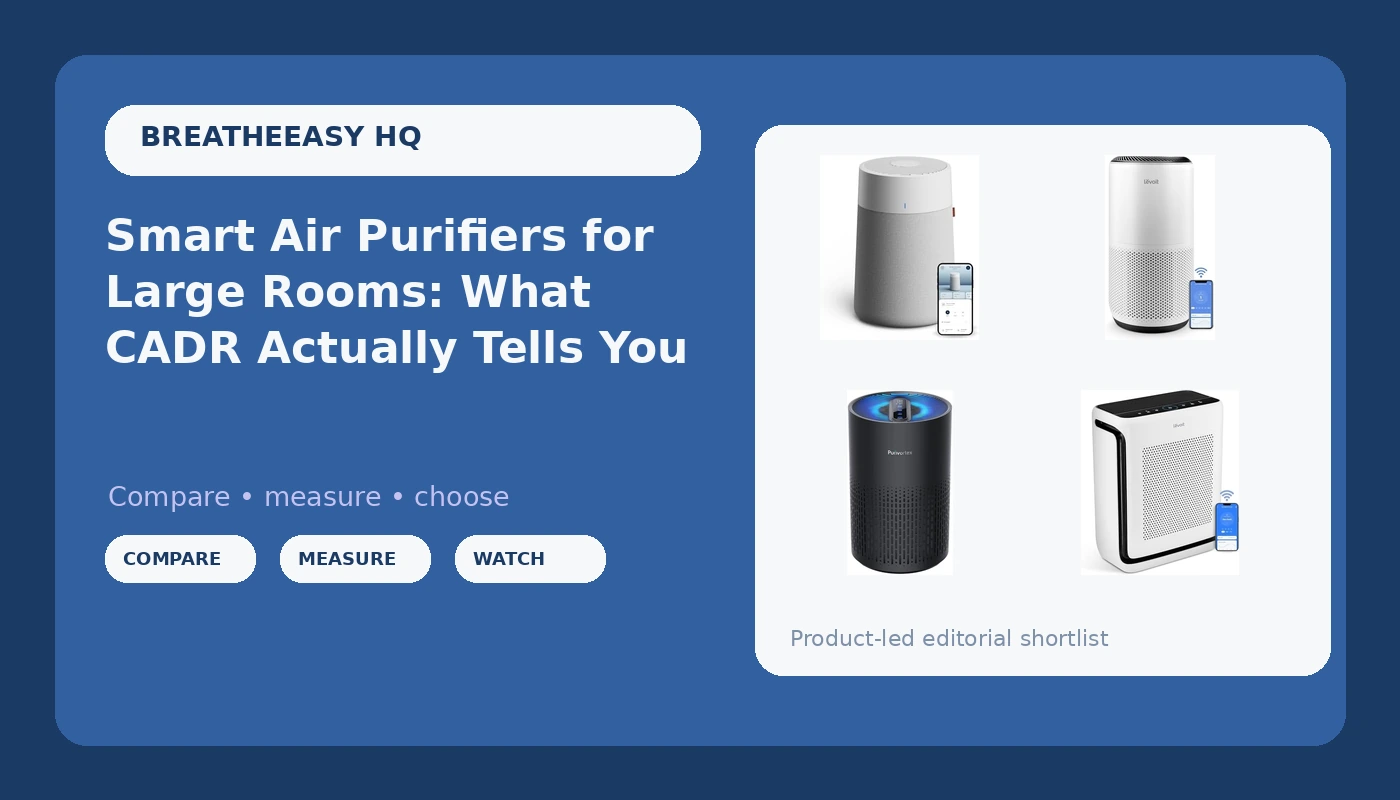
Match the purifier to the room you actually have, then compare CADR at the speed you will realistically run it. For a bedroom or small room, the Blueair Blue Pure 511i Max is built around that use case, with WiFi, Auto Mode, and a manufacturer coverage claim up to 1,138 square feet. For larger living spaces, the Levoit Core 400S-P and the Levoit Vital 200S-P carry manufacturer coverage claims of 1,733 and 1,875 square feet respectively. The Purivortex PX500 Black sits in the middle at 880 square feet and is positioned as a bedroom unit rather than an app-first whole-floor machine. Every coverage figure here comes from the manufacturer, so verify the CADR numbers on each listing before you buy.
Four useful options
| Model | Best fit | What stands out |
|---|---|---|
| BLUEAIR Blue Pure 511i Max | Bedrooms and small rooms | HEPASilent filtration with WiFi and Auto Mode; manufacturer coverage claim up to 1,138 sq ft |
| LEVOIT Core 400S-P | Large rooms and open living areas | Smart controls; manufacturer coverage claim up to 1,733 sq ft |
| Purivortex PX500 Black | Bedrooms, simple setup | Manufacturer coverage claim up to 880 sq ft; listing does not lead with app control |
| LEVOIT Vital 200S-P | The largest rooms in this group | Smart controls; manufacturer coverage claim up to 1,875 sq ft |
Small-room pick: BLUEAIR Blue Pure 511i Max
The trade-off with a small-room unit is that the coverage claim is doing double duty as a use-case label. Blueair frames this one for bedrooms and small rooms, which is where most people want a purifier to disappear into the background. Auto Mode is convenient, but it responds to particulate readings, not odors, so it will not necessarily ramp up for cooking smells or a litter box. Filter replacement is a recurring cost on every unit in this article, and the replacement filter price is worth checking before you commit, because a cheap machine with expensive filters is not cheap after a year. Also look at how the filter seats in the housing. Air that sneaks around the filter instead of through it is the most common way a purifier underperforms its spec sheet.
Large-room pick: LEVOIT Core 400S-P
A 1,733 square foot claim assumes an eight-foot ceiling and a certain air exchange rate, and it assumes the air in the room actually reaches the machine. In an open floor plan, that second assumption is doing a lot of work. One purifier at one end of a long room will not clean the far end evenly, no matter what the box says. Run it on a higher speed when the room is occupied, and accept that the quiet settings are quiet because they move less air. Physics does not negotiate on that point. The practical question is whether the CADR at medium speed is high enough for the space, since medium is where most people actually leave a purifier running.
Bedroom alternative: Purivortex PX500 Black
The PX500 Black is the outlier here, and that is not automatically a knock. Its listing does not foreground app control or WiFi the way the other three do, which matters if you want scheduling and remote control, and matters in reverse if you would rather not add another device to your network. A purifier that turns on with a physical button is not a lesser purifier. It is a different set of trade-offs, and the specs that decide whether it cleans your room are the same ones: CADR, seal quality, and filter cost. The 880 square foot claim is a manufacturer figure, and it should be checked against the CADR numbers on the listing rather than taken as a floor plan.
Largest coverage claim: LEVOIT Vital 200S-P
A larger coverage claim does not automatically mean better cleaning, and it does not mean you should buy the biggest number in the table. What it usually means is that the manufacturer tested the unit at a higher fan speed in a larger space, which often translates to more noise at the setting you need to reach that coverage. Read the claim as a ceiling, not a target. If your room is 400 square feet, a unit rated for 1,875 square feet will not clean it four times as well. It will clean it well at a lower, quieter speed, which is a real benefit. That is the honest way to use an oversized claim: buy headroom so you can run the machine on medium instead of max, not because the number itself is meaningful.
Prices and availability may change. Product images, names, and retailer links must be matched by verified ASIN. Do not state a current price, rating, stock status, or measured result without current evidence.
Why CADR matters more than the coverage number
CADR stands for Clean Air Delivery Rate, and it is expressed in cubic feet per minute of clean air delivered. It is the single spec that predicts how a purifier will perform in a real room, because it combines two things that coverage claims quietly separate: how much air the fan moves and how much of the particles in that air the filter actually removes. A powerful fan with a leaky filter housing can post a high airflow number and still leave particles in the room. A tight filter with a weak fan will clean thoroughly but slowly.
Manufacturers that participate in the AHAM Verifide program publish three CADR figures for each unit: smoke, dust, and pollen. Those are the numbers to compare, because they are measured under a standardized test rather than a marketing department's idea of a room. A common rule of thumb is that CADR in cubic feet per minute should be at least two-thirds of the room's square footage, which yields roughly 4.8 air changes per hour in a room with an eight-foot ceiling. A 300 square foot bedroom, then, wants a CADR around 200 or higher. A 600 square foot living area wants roughly 400. If a listing advertises a huge coverage area but will not publish a CADR, that is a signal worth noticing.
Two other specs matter as much as the fan rating. The first is the seal: if the filter does not seat tightly against the housing, air takes the path of least resistance and bypasses the filter entirely, which is the number one failure mode on inexpensive units. The second is noise at the speed you will use. A purifier that only hits its rated CADR on a setting you cannot stand is effectively a lower-CADR purifier, because you will turn it down. Decibel ratings at each speed tell you more than a "quiet" badge.
What "smart" actually adds, and what it does not
Smart features are not filtration. They are control and feedback layered on top of the same fan and filter. The most useful of them is scheduling, because a purifier running on a timer in a bedroom before you sleep does more for your air than one you remember to switch on twice a week. Auto Mode is the second useful feature, and it is also the most misunderstood. These units use onboard sensors that read particulate matter, typically PM2.5. They do not read odors, volatile organic compounds, or carbon dioxide reliably. That means Auto Mode will respond to smoke, dust, and pollen, and it may do nothing at all about cooking smells or a litter box.
App dependency is the real cost of the smart layer. A purifier that requires an app to reach its full feature set is a purifier that stops being fully controllable if the app is abandoned, the WiFi changes, or the manufacturer's cloud service is retired. That is not a reason to avoid smart units. It is a reason to check whether the essential functions, power, speed, and filter life, still work from the physical controls. Filter life indicators are usually runtime estimates rather than measurements of actual loading, so treat them as reminders, not diagnostics.
- Measure the room's length and width, and note the ceiling height if it is not eight feet.
- Find the CADR figures on the listing, ideally smoke, dust, and pollen values from a standardized test.
- Compare CADR to room area, aiming for a CADR at least two-thirds of the square footage.
- Decide whether you need app control, scheduling, or Auto Mode, or whether physical controls are enough.
- Look up the replacement filter price and estimate the yearly cost before you buy the machine.
Practical guidance before you order
- Treat a coverage claim as marketing until you find a CADR figure that supports it.
- Run the purifier on the highest speed you can tolerate while you are in the room; low settings clean slowly.
- Keep the unit a few feet from walls and furniture so intake and exhaust are not blocked.
- Vacuum or rinse the prefilter on a schedule; it catches hair and dust so the HEPA stage lasts longer.
- Replace filters when the manufacturer recommends it, since a loaded filter reduces airflow and effective CADR.
- If allergies are the driver, prioritize the bedroom and run the unit before sleep rather than in the middle of the day.
- Budget the filter cost as part of the purchase, not as an afterthought.
Which option should you choose?
Choose the BLUEAIR Blue Pure 511i Max when your priority is a bedroom or small room and you want WiFi control with Auto Mode in a unit marketed specifically for that space. Choose the LEVOIT Core 400S-P when you are cleaning a large room or an open living area and want smart controls plus a filter family that is widely stocked. Choose the Purivortex PX500 Black when you want a bedroom-focused unit with a simpler control approach and do not need app connectivity. Choose the LEVOIT Vital 200S-P when you want the largest manufacturer coverage claim in this group and the headroom to run on a lower, quieter speed in a mid-size room.
Every coverage figure in this article is a manufacturer claim, not an independent measurement, and the same goes for feature descriptions drawn from the listings. Verify the CADR numbers, the replacement filter price, and the return policy on the listing before you commit, because those three details decide more about long-term satisfaction than the badge on the front of the machine.
The bottom line
The square-foot number on the box is a starting point, and CADR is the spec that tells you whether the claim holds up. Find the CADR, compare it to your room area, confirm the filter seats tightly, and price the replacements before you buy. Do that and the four units here sort themselves out: the Blueair Blue Pure 511i Max for bedrooms and small rooms, the Purivortex PX500 Black for a simpler bedroom setup, and the Levoit Core 400S-P or Vital 200S-P when the room is large enough that you want airflow headroom. Buy for the room you have, not the number that looks most impressive.