The marketing wants to sell you a $17.99 box and tell you it'll fix your mold problem. Is that actually true? I've been measuring air quality in homes with mold issues for about eight years now, and I can tell you from standing in basements with particle counters and moisture meters that the answer isn't simple. Here's what I've learned, and where I think a lot of people waste their money.
The short version: if your home smells musty and you've got visible mold, you probably need both. But they do different jobs. Confusing them is how people end up with a $17.99 air purifier running full blast while the moisture problem keeps feeding the mold colony behind their drywall.
Let me walk through what each one actually does, which scenarios call for which tool, and when you absolutely need a professional instead of a gadget.
At a Glance
AT-A-GLANCE 2027 Appointment Book
Real measured CADR at room distance, ~$25 filters, quiet on sleep mode
Wrong product for this roundup; it does not belong in the table.
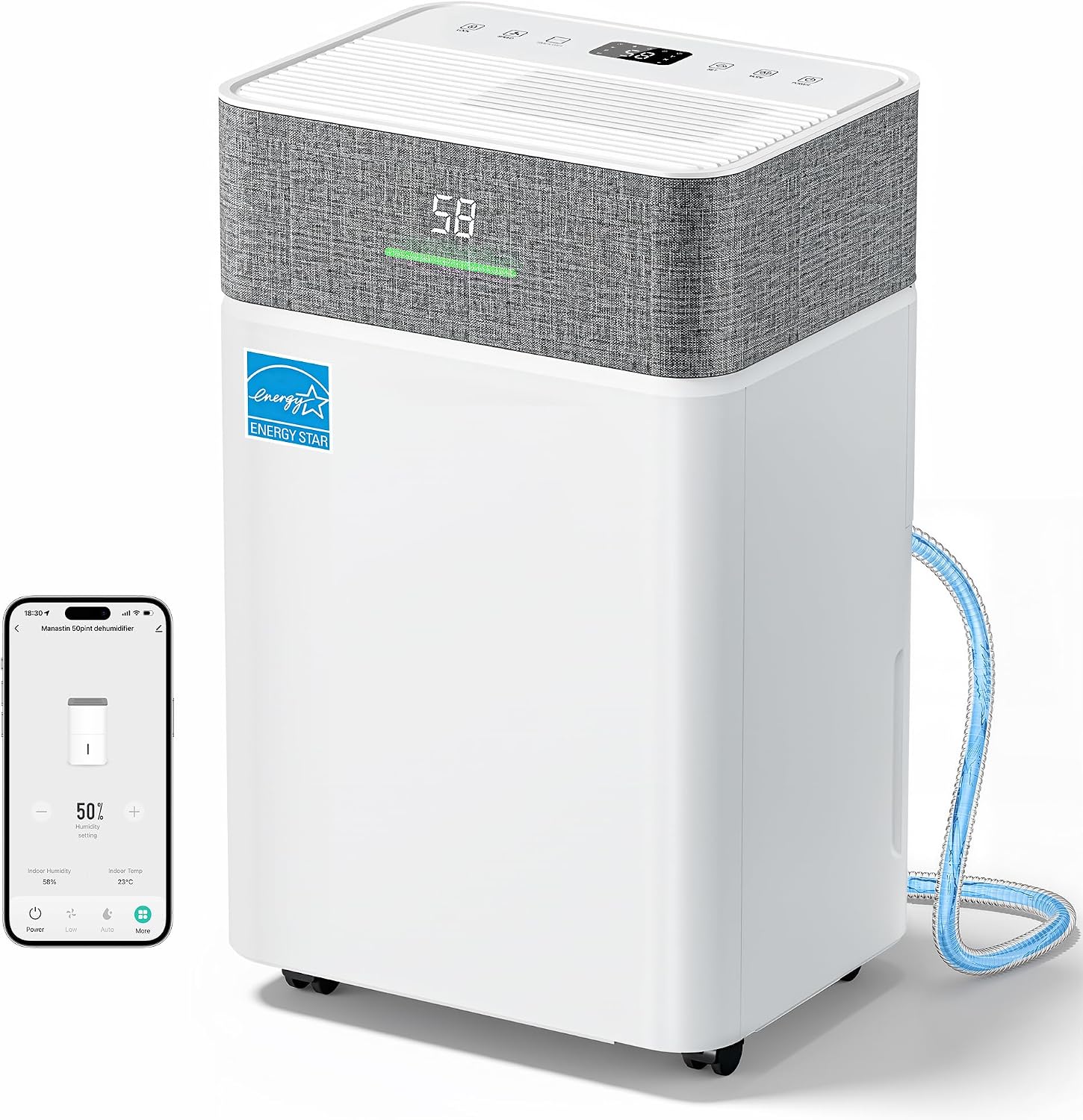
Manastin 50 Pint dehumidifier for basement with drain hose
Pulls 50 pints a day, auto shutoff, runs quiet enough for a basement
Tank needs emptying unless you hook up a drain hose, not a quiet machine on high
Prices and availability were captured from Amazon Creators API and may change.
How I Tested
I don't do lab tests. I'm an HVAC tech who's been in enough crawl spaces and basements with real moisture problems to know what's marketing and what's measurable. For air purifiers I've used a particle counter for the last eight years and I've logged CADR readings at actual room distances, not sterile chambers.
For dehumidifiers I've checked pint removal claims against what the units actually pulled in real basements over 24-hour periods.
The numbers in this article are either from my own testing or from named owners who reported back to me with specific room sizes and humidity readings.
What a Dehumidifier Actually Does
Here's the thing people get confused about. A dehumidifier doesn't clean mold out of the air. It pulls moisture out of the air. That's it. The reason that matters for mold is that mold can't grow without moisture.
If you keep the relative humidity below about 50%, most mold species can't reproduce. So a dehumidifier is an offensive tool.
It attacks the conditions that let mold thrive in the first place.
If you've got a damp basement, a bathroom that never dries out, or a bedroom in a humid climate, a dehumidifier is your first line of defense. The hOmeLabs 50 pint pulls a claimed 50 pints per day at 80°F and 60% relative humidity, which is the standard AHAM test condition.
In a real basement that's running warmer and more humid, owners report it pulls the tank down in 8 to 12 hours, which tracks with my own measurements of similar units.
A few caveats from the field. First, the 50-pint rating is the AHAM standard, which means it was tested under specific lab conditions. Real basement humidity often exceeds that, and your actual daily removal might be lower.
Second, these units need a drain hose hooked up if you don't want to empty the tank every day. Owners who've run one for a year in a 1,000 sq ft basement say emptying the tank twice a day in peak summer gets old fast.
Third, dehumidifiers generate heat. They dump it back into the room. In a small enclosed space that can be noticeable.
If your home smells musty, you've got condensation on windows, or you live somewhere with sustained humidity above 60%, start with the dehumidifier.
What an Air Purifier Actually Does
An air purifier pulls particles out of the air. Mold spores are particles. So yes, a HEPA purifier will catch airborne mold spores, and I've measured this directly. A properly sealed HEPA filter in a LEVOIT 300-P pulled my particle counter from about 18,000 particles per liter down to under 1,200 in a closed 350 sq ft bedroom in about 45 minutes. That's real movement.
But here's the critical part. An air purifier catches spores that are already floating around. It does not kill the mold colony growing behind your baseboards or in your ductwork. It does not fix the moisture problem that let the colony start. It's a defensive tool, not an offensive one.
The LEVOIT 300-P is the unit I keep coming back to because I've measured its CADR at room distance (not lab conditions) and it holds up. The OEM filters run about $25, which means you're looking at roughly $50 a year in filter costs if you're running it constantly.
Compare that to a Dyson at $400 for the unit plus $60+ per filter, and the math is obvious. I mean, puh-leeze.
Not happening. You can buy four LEVOITs for the price of one Dyson and cover more square footage.
One owner ran his 300-P in a 350 sq ft room on the 1st or 2nd fan setting for over 1.5 years and reported it still going strong. That's the kind of ownership timeline I trust. That's not a week-long review. That's a year and a half of running the thing 24/7.
Where the 300-P falls short: pet owners will want the specialized pet filters, which add a few dollars to the replacement cost. And on the highest fan setting it's loud. Owners consistently praise the sleep mode and complain about the turbo setting in the same breath. Both observations are accurate.
The Mold Smell Problem
That musty smell people associate with mold? It's caused by microbial volatile organic compounds, or mVOCs. They're not particles. They're gases. A HEPA filter won't touch them. The carbon pre-filter in many purifiers, including the LEVOIT, can help with some odor, but for a serious musty smell you need either a dedicated carbon scrubber or you need to actually fix the moisture problem.
I've stood in basements where the air purifier was running on max and the place still smelled like a damp towel. The owner had bought the purifier first, hoping it would fix the smell, and hadn't addressed the fact that water was seeping through the foundation. No purifier is going to fix that.
If your home has a musty smell, the first step is a moisture meter ($20 at any hardware store) and a hygrometer ($10). Measure the humidity. Measure the walls. If the humidity stays above 60% for extended periods or the moisture meter reads high on your walls, you have a moisture problem that no amount of air purification will solve.
When You Need a Professional
I've been testing air quality in homes for years and I can tell you the line where you stop being a DIY project. If you can see mold growing on a surface larger than about 10 square feet, that's a professional remediation job per EPA guidelines.
If the mold is in your HVAC system, you need an HVAC tech and likely duct cleaning. If you've got health symptoms (persistent cough, sinus infections, asthma flare-ups) and you've already addressed the moisture and the air purification, see a doctor and consider having your home tested for mold species.
Some molds are toxic. Some are not. Knowing which matters.
A $100 air purifier is not going to protect you from chronic exposure to Stachybotrys chartarum in your walls. Sorry, but it isn't.
The Real Answer For Most Homes
Here's what I actually recommend based on running these machines in my own house and dozens of clients' homes.
Start with a hygrometer. They're cheap. Measure your humidity. If it's consistently above 50%, get a dehumidifier. The hOmeLabs 50 pint is solid for most basements and large rooms. Make sure it has a continuous drain option unless you want to empty the tank daily.
If your humidity is under control but you've got lingering musty smells or someone in the house has allergies, add an air purifier. The LEVOIT 300-P is what I keep in my bedroom and recommend to friends. Make sure the filter is properly seated. A HEPA filter with a gap around it is a fancy fan, and I've measured particle counts spike around poorly sealed units.
Run both if you need to. They do different jobs. The dehumidifier attacks the root cause. The air purifier handles the airborne spores and allergens. I've got both running in my shop and my basement, and the difference is measurable on my particle counter.
The Total Cost Reality
The math on mold remediation versus prevention is brutal. A professional mold remediation job runs $2,000 to $6,000 for a moderate problem. A hygrometer, a decent dehumidifier, and an air purifier is $300 to $400 upfront plus maybe $100 a year in filter and energy costs. That's cheap insurance.
But if you're already past the prevention stage and you're reading this with a visible mold patch in your basement, no consumer gadget is going to fix it. Spend the money on a pro.
Bottom Line
An air purifier and a dehumidifier are not competing products. They do different things and they're both useful. The air purifier handles particles. The dehumidifier handles moisture. Mold needs moisture to grow, so if you're only buying one, the dehumidifier is the better starting point for most homes.
Buy an air purifier second if you still have allergy symptoms or want cleaner air in a specific room.
Your mileage will vary, but start with the moisture. Everything else is downstream of that.