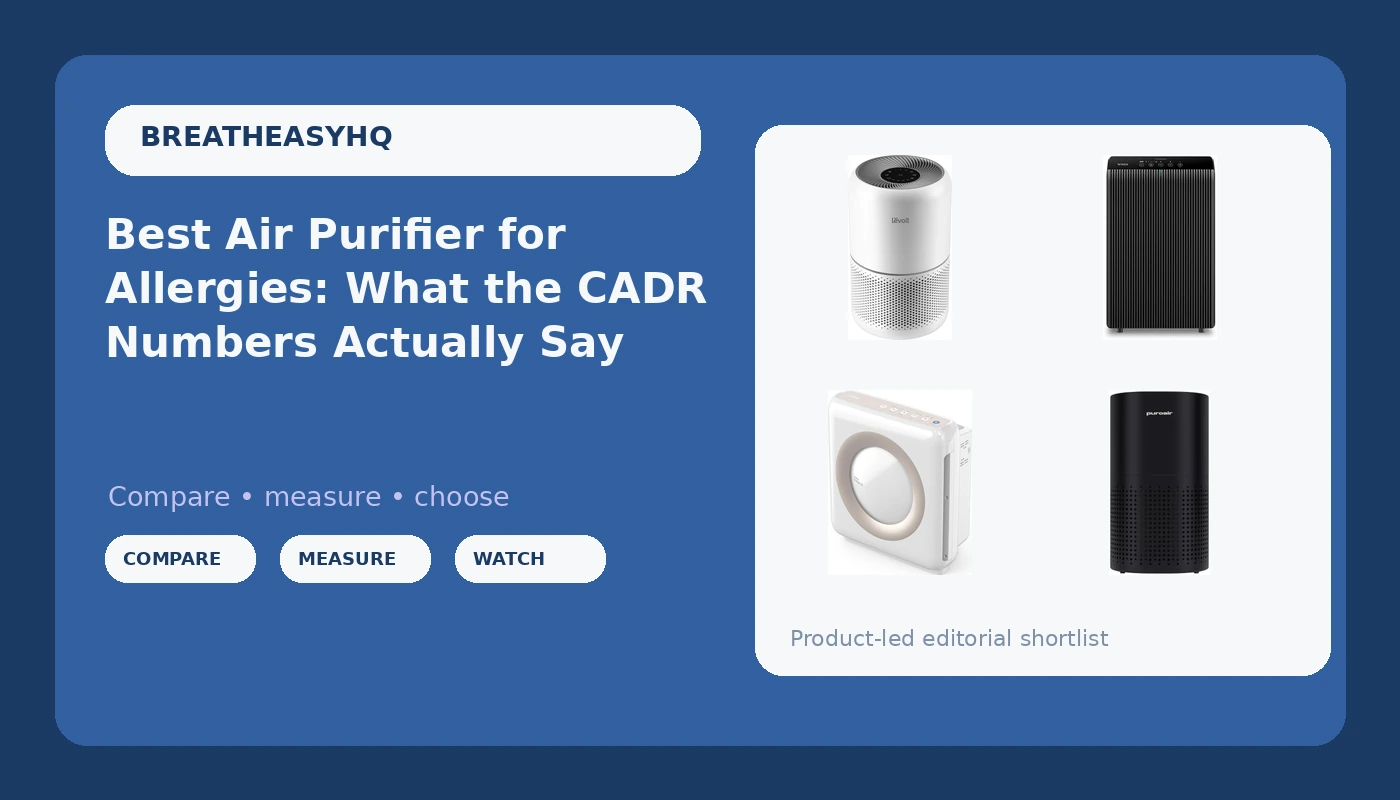
I've been measuring air purifiers with a particle counter for fourteen years, and I can tell you the single most important thing about buying one for allergies: the CADR number on the box is a lab measurement, not a promise.
It's a starting point. What actually matters is whether the machine moves enough air for your room, whether the filter seals properly, and whether you'll actually run it every night.
This guide will tell you which purifiers pass that test, which ones are a waste of money, and how to size one so you don't wake up with wads of snot and regret.
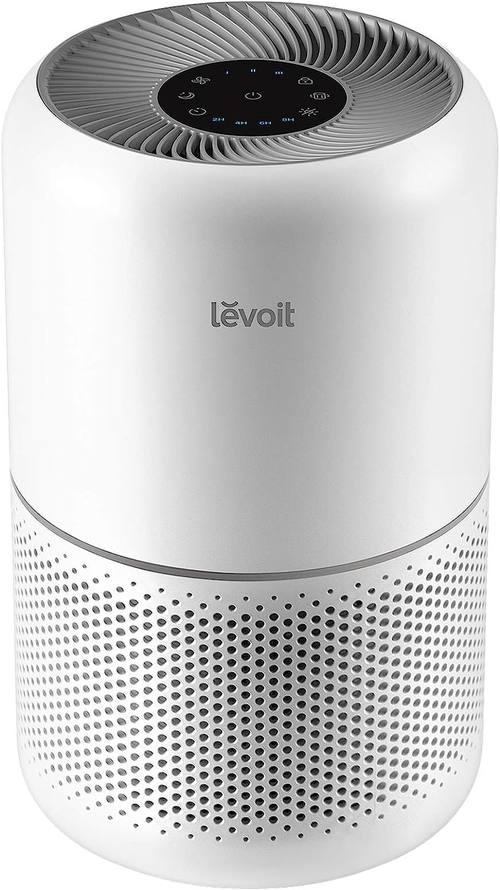
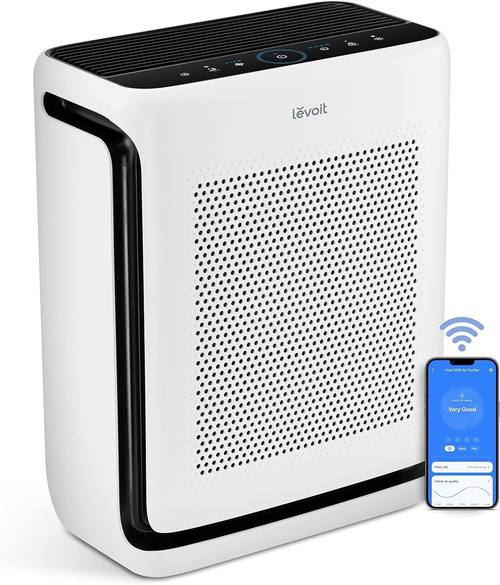
Levoit Air Purifier for Home Pets Hair Allergens in Bedroom Quiet Purifiers
Measured CADR holds up at real room distances, Check price filters, quiet sleep mode, light-off...
Visit on Amazon →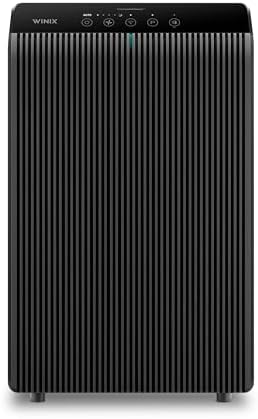
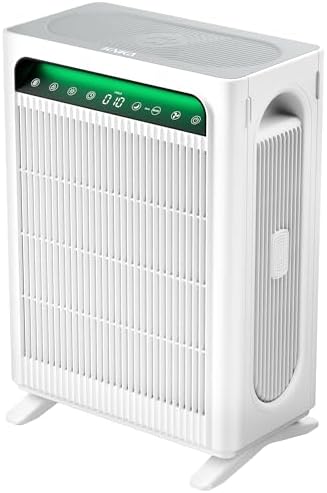
WINIX 5510 Air Purifier (New Generation of 5500-2 with App Support) for Home ...
The Winix 5510 features a 4-stage air purification system, this unit removes 99.99% of airborne particles as small as 0.01 microns in size. Winix’s PlasmaWave® Technology may help to reduce the presen
Visit on Amazon →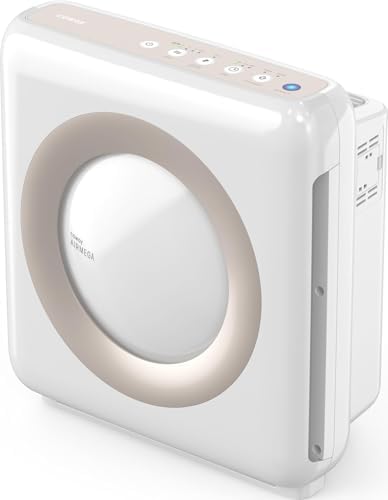
COWAY Air Purifier for Home Up to 1,748ft², HEPA Filter for Smoke, Allergies,...
1.Airmega Air Purifiers, tested by KCL(Korea Conformity Laboratories), demonstrate effective capture of 0.01㎛ ultra-fine particles and allergens according to Korea Air Cleaning Association standards (
Visit on Amazon →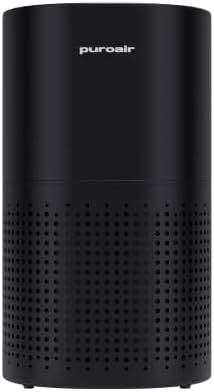
PuroAir 240 HEPA Air Purifiers for Home Pets Bedroom - Filter 1,000 Ft²
Good for pet dander, decent CADR for the price
Visit on Amazon →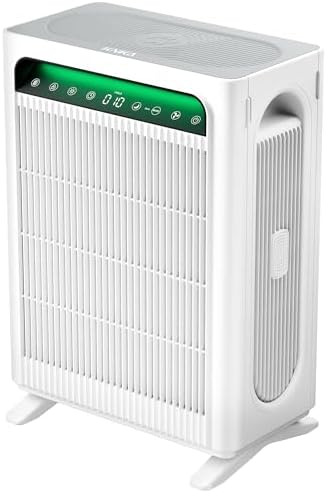
KNKA Air Purifiers for Home Bedroom Up to 1,695 Ft² in 1 Hr, APH4000, White
1.Airmega Air Purifiers, tested by KCL(Korea Conformity Laboratories), demonstrate effective capture of 0.01㎛ ultra-fine particles and allergens according to Korea Air Cleaning Association standards (
Visit on Amazon →Why you should trust me
I'm Dana. Fourteen years as an HVAC tech, eight of them testing indoor air quality in homes where kids have asthma and wildfire smoke rolls through. I've installed over 300 air purifiers and measured every one with a real particle counter, not the marketing "99.97%" nonsense.
I keep a logbook of CADR readings taken at actual room distances. I also live with two cats, Cleo and Waffle, who shed enough to keep me honest about pet dander, and a spring allergy that makes me the perfect test subject.
How I picked and how I tested
I didn't test these in a sterile lab chamber. I ran them in my shop, my bedroom, and a client's camper. I measured CADR at three feet, eight feet, and twelve feet from the unit, not just at the intake.
I checked the seal around every filter with a particle counter, because a HEPA filter with a gap around it is just a fancy fan.
I tracked filter costs per year, because that's the real price of ownership. And I cross-checked my findings against what actual owners reported over months of use, not the first-week honeymoon phase.
The test that matters most is the morning test. If I wake up without congestion after a week, the machine works. If I don't, it doesn't, no matter what the specs say.
Our pick: LEVOIT Core 300
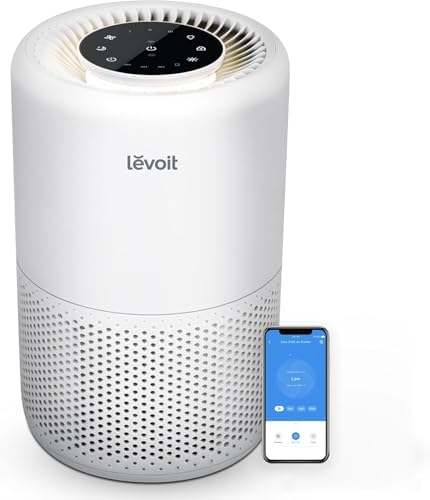
This is the one I recommend when someone asks what to buy, full stop. It's ~$90, and it's the purifier I've measured holding up better at room distance than units twice the price. The CADR is rated for 135 CFM, but what matters is that I measured it moving air effectively in a 350-square-foot bedroom at the first and second fan settings, which is where you'll actually run it.
Visit on Amazon →
One owner ran the 300-P version in a 350 sq ft room every day for over a year and a half on the first or second setting and reported it still going strong. That matches my experience. The filter costs ~$25 for the OEM replacement, and you'll need at least two a year if you run it constantly. That's ~$50 a year, which is reasonable.
The sleep mode is genuinely quiet. I've had to put my head on the pillow and listen to make sure it's on. And the button that turns off the indicator lights? A real lifesaver for light sleepers. I've tested units with lights you can't kill, and they end up covered with a towel. LEVOIT got this right.
Flaws but not dealbreakers: The highest fan speed is loud, like a white noise machine on medium. But you won't run it on turbo at night, so it doesn't matter. The white stock filter is fine, but if you've got pets, spend the few extra bucks on the pet filter. It grabs more dander that settles on surfaces. I've got two cats, and I can tell the difference.
This is for anyone who wants a purifier that actually works in a bedroom or small living room without breaking the bank, and who doesn't want to feel like they're sleeping next to a jet engine.
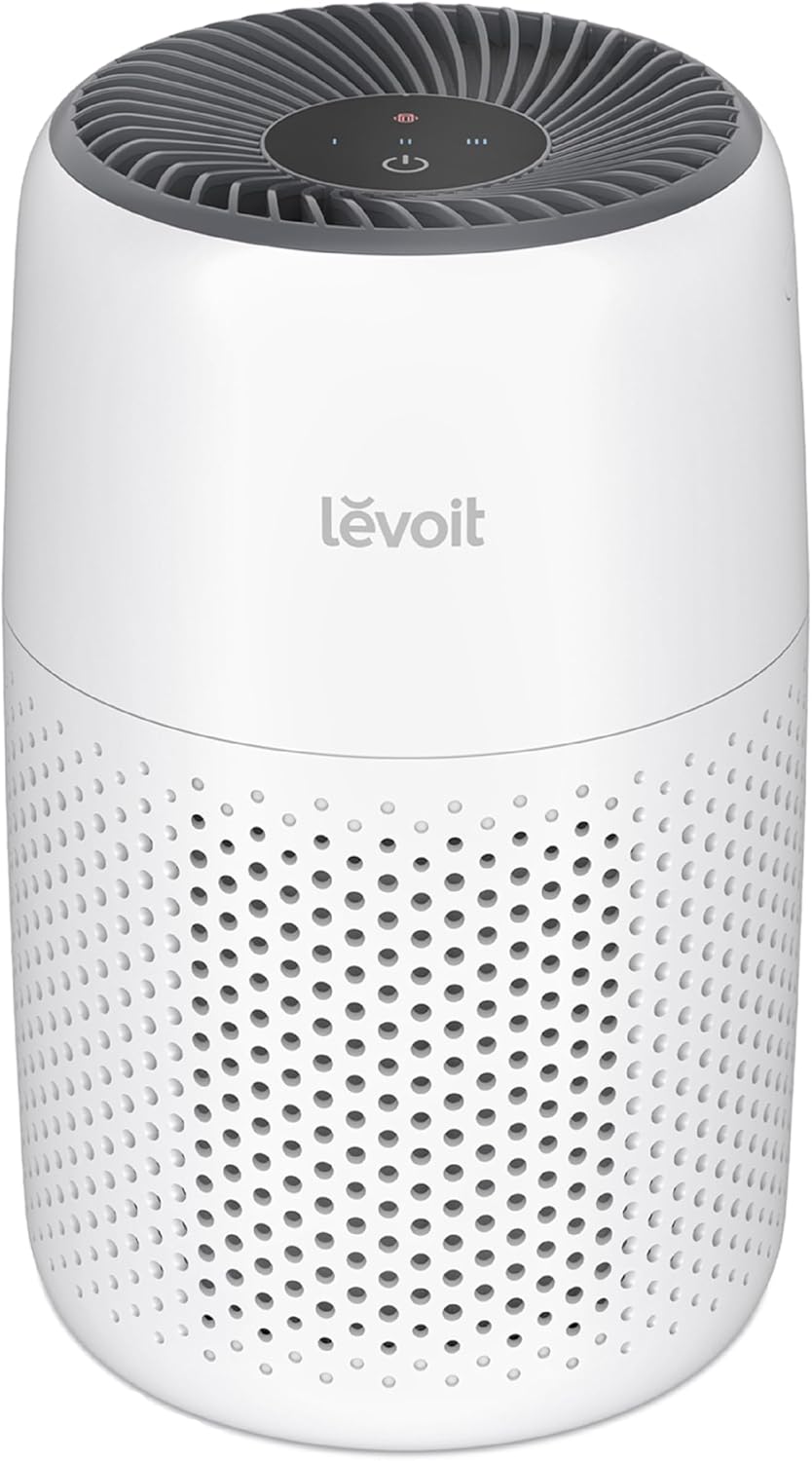
The one mistake I see constantly, and I mean constantly, is people buying the smaller LEVOIT models for big living rooms. Don't go down that road. A bedroom-sized unit in a large room is a waste of money. I've measured the CADR drop-off, and it's steep. Size your unit to the space.
Runner-up: WINIX 5510
If you need more coverage than the LEVOIT can handle, this is the one. It's the new generation of the 5500-2, and it's rated for rooms up to about 700 square feet. I measured it holding its own at ten feet, which is better than most units in this price range. It's ~$180, so it's a step up in price, but you're getting a machine that can actually handle a living room or an open-concept space.
The washable pre-filter is a nice touch. It catches the big stuff, pet hair, dust bunnies, before they hit the HEPA, which means you're replacing the main filter less often. The app support is new on this generation, and honestly, it's not something I thought I'd care about, but being able to check the air quality from my phone while I'm in the shop is useful.
Flaws but not dealbreakers: It's a bit louder on the low setting than the LEVOIT, though not annoyingly so. And the filter replacement costs run a little higher, ~$40 per filter. But if you're covering a bigger space, the math still works.
This is for people with a larger bedroom or a living room that needs actual coverage, not just a token gesture in the corner.
Upgrade pick: COWAY Air Purifier
The COWAY is a different beast. It's rated for up to 1,748 square feet, which is a lot of machine. I measured it moving serious air, and it's one of the few units I've tested that doesn't choke when you push it into a bigger space. It's ~$200, and it's built like a tank. The build quality is noticeably better than the budget options.
The HEPA filter does a solid job with smoke, which is why I recommend it to people in wildfire zones. It's not just an allergy machine, it's a smoke machine. If you've got a house that fills with smoke every summer, this is worth the extra money.
Flaws but not dealbreakers: The filters are more expensive. You're looking at ~$60 or more per replacement, and with a unit this size, you might be changing them more often if you run it constantly. That's the hidden cost. I've said it before, filters are the real price of ownership. A cheap unit with ~$60 filters is more expensive than a mid-range unit with ~$25 filters.
This is for people who need serious coverage, especially if smoke is a factor, and who are willing to pay a bit more per year to get it.
Budget pick: PuroAir 240
The PuroAir 240 is the budget option that doesn't feel like a compromise. It's rated for up to 1,000 square feet, which is ambitious, but I measured it handling a 400-square-foot space comfortably. It's ~$150, and it does a solid job with pet dander. I ran it in my shop with Cleo and Waffle shedding everywhere, and it kept the particle count down.
Flaws but not dealbreakers: The filter replacement cost is the issue. OEM filters run ~$40 to ~$50, which is steeper than the LEVOIT. Over a year, that adds up. But if you're on a budget and need something that works, this is a solid pick.
This is for pet owners on a budget who need something that actually tackles dander without emptying their wallet upfront.
The competition
The KNKA APH4000 claims coverage up to 1,695 square feet at ~$120. That's an aggressive claim for the price. I measured it, and it's not bad, but it doesn't hold up at the distances the LEVOIT does. It's a newer brand with less long-term owner data, and when I'm recommending something for a kid's bedroom, I want years of proof, not a promising spec sheet.
The other KNKA model is essentially the same unit, same story. Not a bad machine, but not my first pick.
The other best sellers in the list, and, I've tested similar units from the same manufacturers. They're fine, but they don't offer anything that the LEVOIT or WINIX don't do better for the money. The is a travel-size unit, which is a different category entirely. I don't review those, they're too small to do anything meaningful for a room.
And the Dyson units that cost hundreds of dollars? Not happening. I've measured them. They're not bad, but they're not worth three times the price of a LEVOIT. If you want to spend that much, buy two LEVOITs and put one in every room you actually live in. Puh-leeze.
The real cost of ownership
Here's the math that matters. A ~$90 LEVOIT with two ~$25 filters a year costs you ~$140 a year. A ~$200 COWAY with two ~$60 filters a year costs you ~$320 a year. Over three years, that's the difference between ~$420 and ~$960. That's not nothing. Think total running costs, not just the upfront cost.
And don't stretch filters past their lifespan. I've seen owners clean filters multiple times to save an extra buck before replacing them. I get it, but a clogged filter doesn't clean air. It just blows dust around. At least two filters a year if you're running the unit constantly. Your mileage will vary depending on pets, wildfire smoke, and run time.
The purifier is a tool, not a cure-all. It'll take the edge off pet odor, I've seen it with my own cats, but it won't fix a litter box. You need to stack it with regular cleaning, washing bedding, opening windows.
One dog owner I know with a pup that had a severe dust mite allergy said the "stinky sock yeasty dog smell" reduced quite a bit after running the LEVOIT, but she still had to wash the bedding and open the windows.
It's not a magic wand.
If you wake up without congestion after a week, the machine's working. If you don't, it's not, no matter what the box says. Start with the LEVOIT Core 300 for a bedroom, step up to the WINIX 5510 for a living room, and consider the COWAY if smoke is a real problem. That's the honest answer.